News
Youth Interfaith Group Holds Town Hall Meeting to Combat Religious Discrimination in Plateau communities


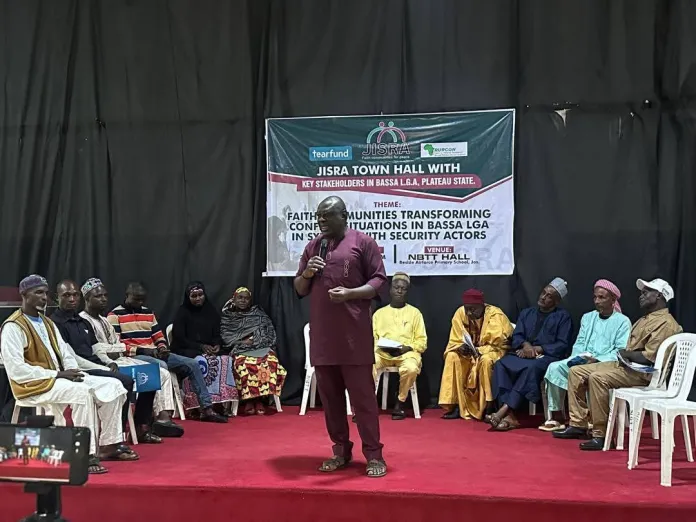
In an effort to address the pressing issue of religious discrimination and promote peace and unity within the community, Dutsen Kura Youth Interfaith Group in the Bassa local government area of Plateau State has partnered with the Rural Communities Development Network (RURCON) to organize a town hall meeting at YWAM 1.
The event, held on September 1, brought together diverse group of community leaders, religious figures, and participants eager to tackle the challenges of religious discrimination.
The Dutsen Kura Youth Lead, Atina Joseph Adick in his welcome remarks expressed the meeting’s purpose.
He said, “The purpose of this interfaith gathering is to discuss the issue of religious discrimination, themed ‘Say No to Religious Discrimination and Violence.’ We have collaborated with JISRA through RURCON, engaging in activities such as sensitization in primary schools and capacity-building training for peaceful coexistence. Today, we gather our elders, religious leaders, and village heads to guide us in our journey towards a more harmonious community.”
Mr. Jallang David, PGM facilitator for the Dutsen Kura community gave an overview on the participatory grantmaking initiative that lead to the organization of the town hall meeting by members of the community.
He said, “The town hall meeting aimed to highlight the importance of participatory grantmaking (PGM) in the Joint Initiative for Strategic Religious Action (JISRA) and its role in transforming power dynamics within the community. Participatory grantmaking empowers local partners and communities to make funding decisions, shifting them from mere beneficiaries to leaders and decision-makers in their own right.”
Ten respected figures from both Christian and Muslim backgrounds addressed the participants:
- Alhajern Muhammed, an Imam, emphasized the true teachings of Islam, urging all to live in peace regardless of religious differences. He denounced those who incite violence in the name of religion, emphasizing the importance of genuine faith.


- Patric Anchuk, a Reverend, highlighted the biblical mandate to live in peace with one another, stating that unity is central to Christianity. He reminded attendees that salvation demands loving one’s neighbor and even enemies.
- Abubakar Yunusi, another Imam, stressed the common origin of both religions and the need to fear God. He called for the immediate resolution of misunderstandings and conflicts.
- Pastor Joseph Auta urged attendees to extend love and forgiveness to all, regardless of their religious beliefs. He emphasized that this commandment applies to everyone, not just fellow Christians.


- Ingmala Auibine, a village head, shared how peaceful coexistence had been a longstanding tradition in the community. He encouraged attendees to let go of differences, resolve conflicts, and share their newfound knowledge with others.
- Ardo Wada called for unity, emphasizing that God created everyone with the same characteristics. He cautioned against being used for political purposes, as it only leads to more suffering.
- Rev. Musa Ugino underscored the responsibility of religious and community leaders in promoting peace. He urged them to stay true to their pursuit of peace and avoid propagating personal interests.


- John Adeupe, a ward head, reminded the audience of generations of peaceful coexistence in the community. He warned against falling victim to politicians’ divisive strategies.
- Ardo Bako questioned why people would discriminate based on religion when they didn’t consider it in other aspects of life, such as medical treatment or transportation. He labeled religious discrimination as childish.


During a Q&A session, participants inquired about the root causes of religious discrimination and its link to politics. The panel addressed the issue of fake clerics spreading false doctrines for personal gain and how poverty could be exploited by politicians to create division.
The leaders offered a way forward, highlighting the importance of forgiveness, upholding true religious teachings, avoiding excessive drinking, and educating oneself to identify fake religious leaders and doctrines.


At the end of the meeting the Field Officer for the initiative, Onuche Ocheja commended the Dutsen Kura community for organizing the town hall meeting and encouraged attendees to become humanitarians rather than promoting religious or ethnic propaganda.
The community’s women leader, Mrs. Blessing, expressed gratitude for the initiative and pledged to share the message of peace in their respective places of worship and communities




The Nigeria Police Force has confirmed the arrest of a 22-year-old man, Umar Ibrahim Gandi Maradun, over a viral video allegedly showing him calling for the use of AK-47 rifles to kill Christians in Enugu and Plateau states.
Politics Nigeria reports that the suspect, a native of Maradun Local Government Area of Zamfara State, was arrested for investigation after the video circulated on social media and sparked concerns over religiously motivated violence.
In a statement issued on Tuesday, October 27, 2026, the Force Public Relations Officer, Chief Superintendent of Police (CSP) Ani Iniedu, said the Zamfara State Police Command had activated its intelligence resources to identify those involved in the incident.
The police also confirmed that the command had engaged the leadership of Jama’atu Izalatil Bidi’a Wa’ikamatus Sunnah (JIBWIS) at the national and state levels following the emergence of the video.
According to the police, the organisation disassociated itself from the alleged conduct and handed the suspect over to the authorities for investigation.
The video reportedly showed the suspect wearing JIBWIS uniform and appearing alongside pupils from two Islamic schools in Maradun: Nurul Islam Islamiya and Akidatul Sahiha Islamiya.
Preliminary findings by the Zamfara State Police Command indicated that the video was recorded on Friday, October 23, 2026, while the suspect was reportedly on his way to Aliyu Ibn Abi Thalib Mosque, where he and others allegedly provided security during Friday prayers and preaching.
The suspect was born on September 15, 2004. He reportedly attended Mualledi Model Primary School and Government Day Secondary School, both in Maradun.
He also reportedly joined JIBWIS in 2025 and recently gained admission to study Mass Communication at Zamfara State University, Talata Mafara.
The police said a comprehensive investigation had commenced and that the suspect would be charged before a competent court if sufficient evidence established an offence under applicable law.
Earlier, the Zamfara State Commissioner of Police, Bello, said the investigation would consider allegations of incitement to violence, disturbance of public peace and criminal intimidation under Sections 77, 78 and 380(b) of the Penal Code Law applicable in the state, subject to the evidence gathered and applicable law.
The police also condemned statements capable of promoting religious hatred, threatening community safety or undermining peaceful coexistence.
“The Zamfara State Police Command remains resolute in its duty to uphold the law, protect lives and property, defend the rights of all citizens without discrimination, and work with relevant stakeholders to sustain peace and security throughout Zamfara State,” the commissioner said.
The development comes as JIBWIS has publicly distanced itself from the video and condemned calls for violence against non-Muslims.
The group’s National Publicity Secretary, Sheikh Ahmad Muhammad Ashiru, stated this in a statement issued at its headquarters in Jos on Tuesday.
Ashiru said the organisation had yet to establish the authenticity of the video but maintained that its position against violence was clear.
“We are yet to confirm whether the video is authentic, but our position against violence remains clear,” he said.
He added that JIBWIS, under the leadership of Ash-Sheikh Muhammad Sani Yahaya Jingir, would not support calls to attack or kill anyone because of their religious affiliation.
Ashiru said banditry, kidnapping, armed robbery and Boko Haram attacks were already affecting communities across the country, warning that statements promoting violence could heighten tensions and threaten peaceful coexistence.
“We would not support any call capable of disturbing the peace of Nigeria, as such comments are capable of inciting violence and creating unnecessary tension among Nigerians,” he said.

The JIBWIS spokesperson stressed that anyone making such statements in the organisation’s name did not represent its position.
He urged security agencies to investigate the video, establish its authenticity and identify those responsible, adding that anyone found culpable should face the law after a proper investigation.
Meanwhile, the Nigeria Police Force has urged members of the public to remain calm, avoid circulating unverified information and refrain from sharing the video in ways that could escalate religious tensions.
The Force reiterated its commitment to protecting Nigerians irrespective of religious affiliation and taking lawful action against conduct capable of inciting hatred or threatening public peace.

Senator Victor Umeh has accused Anambra State Governor Chukwuma Soludo of acting out of envy and hatred towards presidential candidate of the Nigeria Democratic Congress, NDC, Mr Peter Obi.
Umeh claimed that Soludo was trying to surpass Obi's political record, insisting that the former Anambra governor remained more popular than his successor in the state and across Nigeria.
The senator made the remarks on Tuesday while fielding questions on Channels Television's Politics Today programme.
Umeh, who said he attended the University of Nigeria, Nsukka, UNN, alongside Obi and Soludo between 1980 and 1984, suggested that their shared academic background might have contributed to what he described as peer envy.
He said, “He (Peter Obi) cannot be drawn to what is called the peer envy and hate. You know, all of us were in the university together. Myself, Soludo, Peter Obi. We were at the University of Nigeria from 1980 to 1984, all of us graduated the same day.
“So sometimes when you see people talk, they talk out of maybe peer envy. He (Soludo) is running after Peter Obi's record.”
The senator further argued that Obi remained more popular than Soludo despite the latter's position as governor of Anambra State.
“Whether he likes it or not, today, no matter what Soludo does, Peter Obi will continue to be more popular than him, both in Nigeria and in Anambra State. Go there and see,” Umeh added.
Obi served as governor of Anambra State from 2006 to 2014. Soludo became governor in 2022.
‘Envy, hate behind Soludo’s attacks on Peter Obi’ – Senator Umeh
-

 News3 days ago
Troops rescued 70 abductees, recovered N10 million ransom: DHQ
-
Business3 days ago
CBN grants JP Morgan approval-in-principle to set up merchant bank
-
News3 days ago
Plateau Activates Ebola Preparedness Measures, Urges Residents to Observe Safety Guidelines
-
Business3 days ago
REA Ends 16 Years of Darkness in Two Kano Communities