Connect with us

News

SSA Adeboye Opens Talks With Morocco on Grassroots Sports Partnership, International Opportunities for Nigerian Talents

info

Published

on

IMG 20261020 WA0051.jpg

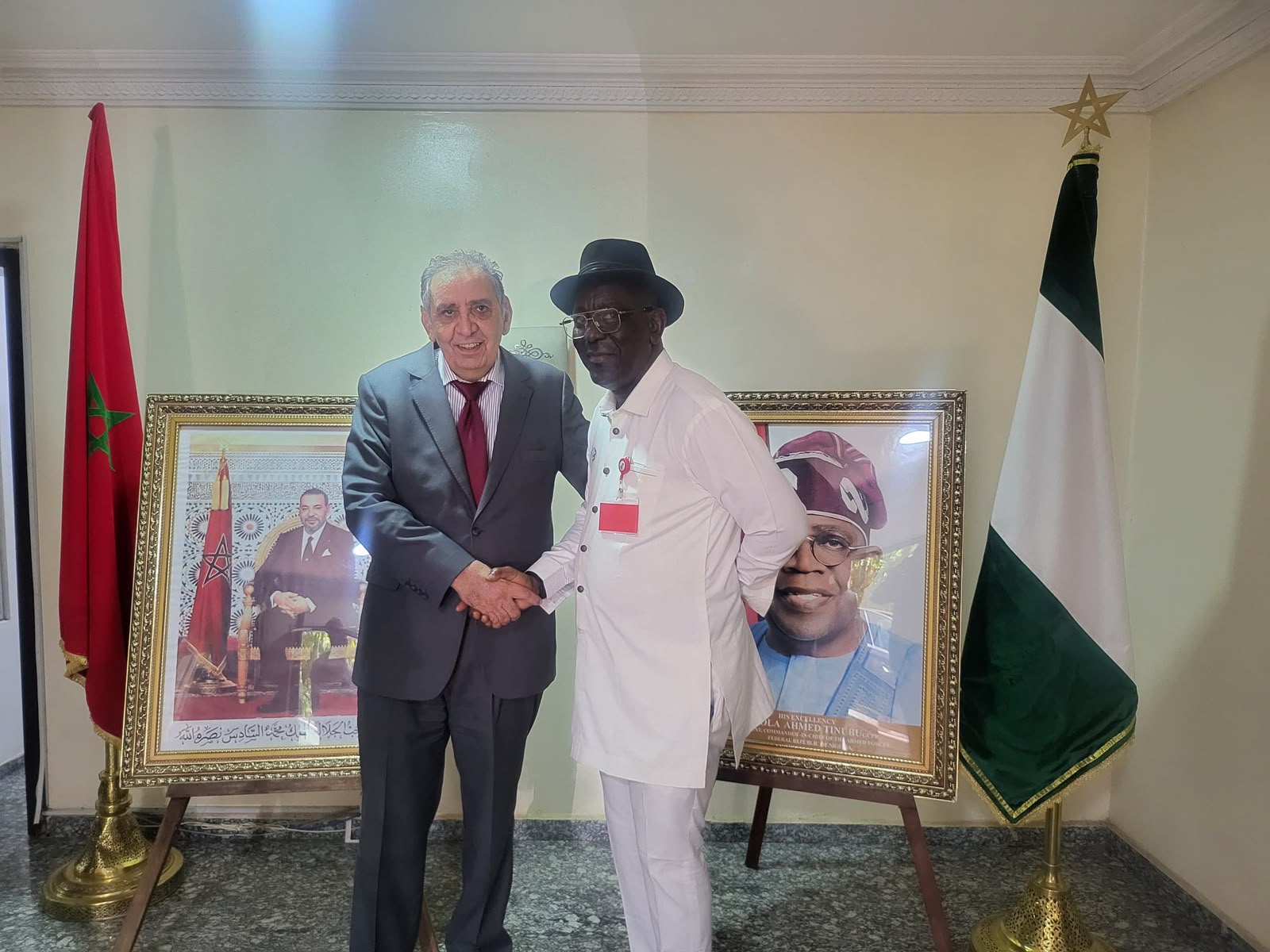
The Senior Special Assistant to the President on Grassroots Sports Development, Hon. Adeboye Anthony Adeyinka, has taken another step towards expanding international opportunities for young Nigerian athletes following a diplomatic engagement with the Ambassador of the Kingdom of Morocco to Nigeria, His Excellency Moha Ou Ali Tagma, in Abuja.

Adeboye, who paid a courtesy visit to the Moroccan Embassy on Tuesday, held discussions with the Ambassador on strengthening bilateral cooperation in grassroots sports development, talent discovery, technical exchange and youth empowerment.

The meeting explored opportunities for both countries to leverage their sporting relationships to create sustainable development pathways for young athletes, coaches and sports administrators.

Speaking during the engagement, Adeboye emphasised that Nigeria’s ambition to become a stronger sporting nation requires strategic international partnerships capable of connecting grassroots talents with modern training methods, technical expertise and competitive opportunities.

“Our responsibility is not simply to discover talents but to ensure they have the right environment, exposure and opportunities to develop. Morocco has made significant investments in sports development, and there are valuable areas where both countries can collaborate for the benefit of our young people,” Adeboye stated.

The Presidential aide noted that sports diplomacy has become an important instrument for strengthening international relationships while creating opportunities for economic growth, cultural exchange and youth development.

He explained that collaboration between Nigeria and Morocco could open doors for coaching education, technical assistance, youth competitions, institutional partnerships and knowledge-sharing initiatives.

“We want partnerships that move beyond discussions to practical programmes. When young athletes, coaches and administrators have opportunities to learn, compete and exchange ideas internationally, the benefits ultimately return to our communities and national sporting system,” he added.

Adeboye also stressed the importance of creating structured pathways through which talented young Nigerians, particularly those emerging from schools, academies and community competitions, can access development opportunities without being limited by their backgrounds.

The visit comes as the Office of the Senior Special Assistant continues preparations for the National Grassroots Sports Development Summit 2026, scheduled for November 18 and 19 at the Banquet Hall, Presidential Villa, Abuja.

The Summit, themed “Creating a New Pathway for Sustainable Grassroots Sports Development,” is expected to provide a platform for strengthening domestic and international partnerships towards a more sustainable sports development framework.

Adeboye expressed appreciation to Ambassador Tagma for the warm reception and constructive discussions, describing the engagement as an encouraging foundation for exploring mutually beneficial cooperation.

“Nigeria and Morocco share a passion for sports and a strong belief in the potential of young people. We must translate that shared interest into opportunities that can positively impact the next generation,” he said.

The Presidential aide reaffirmed his Office’s commitment to pursuing partnerships that strengthen grassroots participation, improve talent development and position Nigerian youths for greater sporting opportunities internationally.

Business

How Your Side Hustle Income Ends Up in Your RSA

info

Published

on

BY NKECHI NAECHE-ESEZOBOR—The income you save through the various side hustles can be contributed into your Retirement Savings Account (RSA).

For workers in the formal sector—such as those in federal government agencies, teachers, parastatals, university lecturers, staffs etc.—this can be contributed as an additional fund via voluntary contributions.

While, for those in the informal sector—such as market women, barbers, traders, students, petty traders, shop owners, etc.—their contributions will go into their Personal Pension Plan account.

All of these must go through Pension Fund Administrators (PFAs) approved by the National Pension Commission, (PenCom).

The post How Your Side Hustle Income Ends Up in Your RSA appeared first on Business Today NG.

Continue Reading

News

Anthropic pitches AI safety bill that may block a model if 50+ people could be killed

info

Published

on

GettyImages 2282033342.jpg

Over the past year, concerns have swirled over the potential dangers posed by artificial intelligence, and debates have raged over the proper path for AI safety. Now, Anthropic appears to have put forth its own vision for how the government might regulate its industry.

Politico recently reported that the AI lab has been shopping around a new draft bill on AI safety that it hopes Congress might consider adopting. The legislation posits certain scenarios in which the release of an AI model could be blocked from distribution.

Those scenarios involve a “foreseeable, imminent risk” — one in which over 50 people are at risk of dying or if over a billion dollars in property damage could result, Politico writes. The catastrophic risk in question must “stem from the creation or release of a biological weapon, the model evading its developer’s controls or a cyberattack,” the outlet notes.

The metrics offered here — 50 people and a billion dollars — are similar to those in a piece of California legislation that was recently passed into law, Senate Bill 53, which similarly defined those scenarios as tantamount to “catastrophic risk.”

Anthropic’s bill suggests that analysis of a model’s potential for disaster could be arrived at via the use of “independent evaluators” who would be registered with the U.S. Commerce Department. These evaluators could potentially be paid by the AI labs themselves — so long as the “payment is not contingent on the evaluations’ results,” Politico writes.

It’s not clear how this proposed system would assure that payments couldn’t influence the evaluation. Demis Hassabis, chairman of DeepMind, posited some months ago that a self-governing AI regulatory body should mimic the financial industry’s Financial Industry Regulatory Authority (FINRA).

In Anthropic’s draft bill, when evaluators determine that an imminent catastrophic risk is posed, they would have 72 hours to contact the Commerce Department about it. The Commerce Department would then have to request to a D.C. judge to halt the model’s release. The legislation would expressly forbid any federal agency from having the discretion to halt the model’s distribution on its own, Politico writes.

Anthropic did not immediately respond to TechCrunch’s a request for comment but a spokesperson did confirm the draft bill to Politico. “This bill represents the proposals outlined in Anthropic’s Advanced AI Framework, which we have been advocating for with federal and state lawmakers since June,” the spokesperson said.

The theoretical risks offered in the draft policy are a little bit far afield from the kinds of incidents that have been top of mind for the tech industry of late. While there are people warning of the potential of human death, the primary concern has largely been the threat of agentic hacking. A rash of incidents in which AI programs have apparently disobeyed their human operators and hacked websites on the open internet has spurred concern that models may be lacking proper security controls.

In an effort to present a solution to the spectacle of crisis that the labs themselves have helped bring about, companies like Anthropic have offered up their own preferred solutions.

Indeed, despite labs’ perpetual warnings that the technology they’re selling could result in the demise of human civilization, they have largely been resistant to mandatory government oversight. Instead, they have suggested a voluntary system of embedded evaluators — supposedly “neutral” third-party observers that are placed inside AI organizations so that they can monitor the models for potential signs of risk or abuse.

Still, Anthropic’s mere suggestion for legislation appears to go slightly further than others’ regulatory proposals offered by the industry, including Nvidia, who’s CEO Jensen Huang recently argued that the AI industry didn’t need any new laws at all.

When you purchase through links in our articles, we may earn a small commission. This doesn’t affect our editorial independence.

Continue Reading

Trending