News
Political Realignment in Plateau Sparks Debate on Accountability and Democratic Responsibility







OPay, one of Nigeria’s leading financial technology company officially launched a new office in Jos, Plateau State capital. This is part of its strategy to enhance financial inclusion, announce it’s presence and boost customer service nationally. The event took place on March 25, 2026, and was attended by local business leaders, community representatives, and OPay executives.

L-R: Head of Partnerships, OPay, Odiase Ikponmwosa Kolawole; HRH Dagwom Rwey Za’ang (Zawan), Sir Christopher Sheku Mancha KSJ, SSG; Chief Operations and Technology Officer, OPay, Dotun Adekunle; Regional Manager, Jos/North East, OPay, Gabriel Kate Adeola; and Team Director, Key Account Merchants, Retail and FMCG, OPay, Isimeme Ayobami Owobu during the official launch of the OPay Office in Jos, Plateau State.
The new office will serve as a hub for individuals and businesses in Plateau State, strengthening support for OPay’s agent, merchant and customers network thereby improving service delivery. The company said the facility is expected to create jobs and drive local economic growth by enabling easier access to digital financial tools.
Speaking at the event, OPay’s Chief Operations and Technology Officer, Dotun Adekunle, said: “Opening this office in Jos allows us to stay closer to the people we serve, better understand their needs, and continue to provide fast, secure, and reliable financial services that improve everyday life. This new office is not just a building; it is a commitment to the people of Jos and Plateau State.”
OPay’s Jos office will support local merchants and businesses, facilitate financial transactions, and enable more Nigerians to access digital payments, including underserved communities. The expansion is part of OPay’s nationwide growth plan aimed at building trust and improving accessibility.
Established in 2018, OPay provides a range of financial services including money transfers, bill payments, ATM cards, airtime/data purchases, POS and merchant payment solutions, licensed by the Central Bank of Nigeria and insured by the Nigeria Deposit Insurance Corporation.
By expanding its physical presence in Plateau State, OPay aims to strengthen community engagement while advancing its mission of financial inclusion for all Nigerians.

Nigeria’s AI startup Intron expands it’s speech platform to 57 languages
Intron, a Nigerian artificial intelligence startup has expanded its speech recognition platform, Sahara, to support 57 languages, adding 24 new ones as it scales operations across healthcare, legal, financial services, and telecommunications.
The upgraded Sahara v2, includes 23 African languages and supports more than 500 African accents. Newly added languages include Hausa, Swahili, Yoruba, Igbo, isiZulu, Kinyarwanda, Twi, isiXhosa, Amharic, and Wolof, among others. The company said language selection was driven by commercial demand.
Intron also introduces the world’s first bilingual Swahili-English automatic speech recognition model designed to handle code-switching, alongside new text-to-speech features and offline deployment options for enterprise users.
The development comes amid growing interest in voice technology across Africa, where most of the continent’s estimated 2,000 languages are primarily spoken rather than written. Industry projections show the global speech recognition market could reach $81.59 billion by 2032.
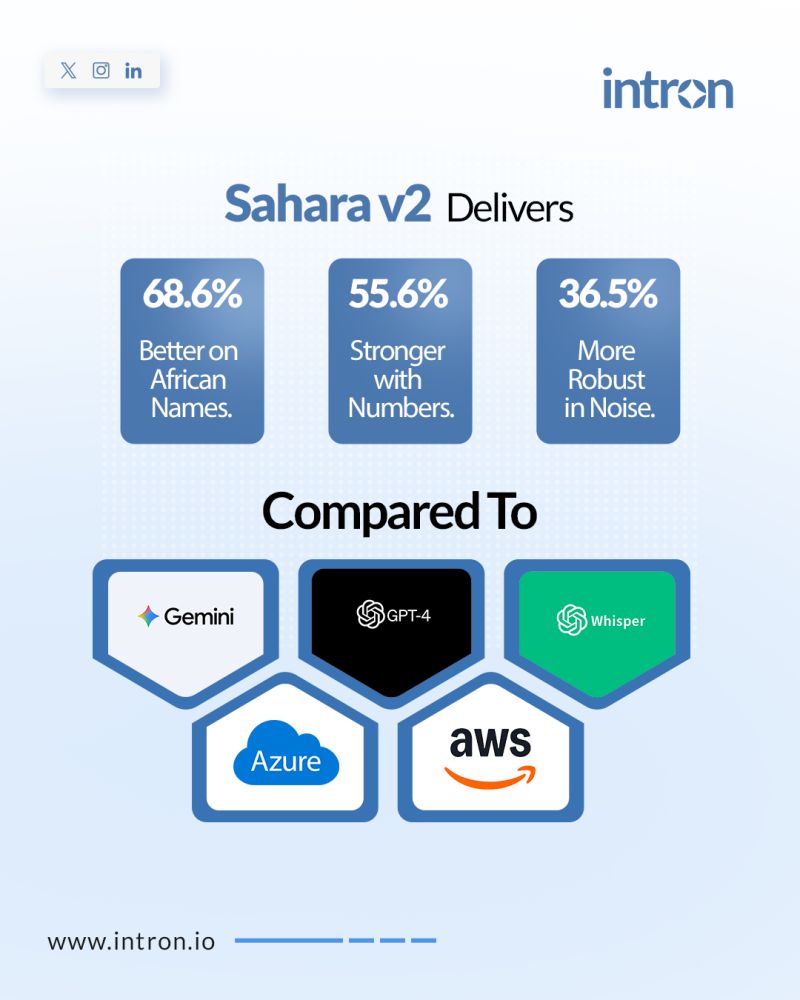
According to Intron, Sahara was trained with locally sourced voice data to better capture African accents, dialects, and speech patterns. The company’s internal benchmarks using African voice datasets showed the platform outperformed global systems such as Gemini, GPT-4, Whisper, ElevenLabs, and Azure by up to 64% in recognising African names, organisations, and locations.

It also reported 35% better performance with numbers, 20% stronger accuracy in noisy or multi-speaker environments, and 25% higher cross-domain accuracy across key sectors.
“We curated datasets of African voices and made them publicly testable so global models can be evaluated on African speech,” said Tobi Olatunji, founder and chief executive officer of Intron.
Founded in 2020 by Olatunji and Olakunle Asekun, the company initially built clinical documentation tools before expanding into broader voice infrastructure. Sahara now powers speech-to-text, text-to-speech, and voice authentication systems for enterprise and government clients.
Intron said it currently records consistent usage in at least six African countries, including Nigeria, Kenya, South Africa, Ghana, Rwanda, and Uganda.
Its clients include the Ogun State Judiciary and Audere, which uses the platform to transcribe WhatsApp voice messages across multiple accents.
Sahara v2 was built using more than 14 million audio clips, representing over 50,000 hours of speech from more than 40,000 speakers across 30 African countries. The company said much of its early medical speech data had to be created internally due to a lack of existing datasets.
The bilingual Swahili-English model was developed in partnership with Penda Health to address real-time language switching common in clinical settings. Intron said additional bilingual models for languages such as Yoruba, Hausa, Zulu, and Kinyarwanda are in development.
The company also launched a Hausa text-to-speech model aimed at powering multilingual voice applications for call centres, healthcare services, and financial platforms.
While Sahara is primarily cloud-based, Intron has introduced offline deployment through a partnership with Nvidia, enabling the system to run on edge devices in low-connectivity environments.
Intron said it complies with local data protection regulations and allows clients to choose between local and cloud data storage.
The company plans to raise $3 million later in 2026 to expand language coverage and further develop bilingual and sector-specific models.
-

 News3 days ago
Gunmen Abduct ECWA Board Chairman in Jos as Insecurity Worsens
-
News15 hours ago
Troops arrest three suspected terrorists, seize AK-47 in Benue
-
Entertainment9 hours ago
Omah Lay Hints at Return to Christianity After Practising Islam
-
News14 hours ago
NPFL: Plateau United must target positive results in remaining fixtures – Ogunbote