Events
Plateau 2023 budget to captures the needs of the people -PSMBEP


The plateau state ministry of budget and economic planning in preparation for the 2023 budget holds a Town Hall meeting with various members of different communities in all local government areas in the central zone to create a more people-centred 2023 budget.
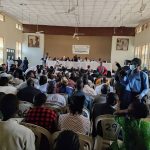
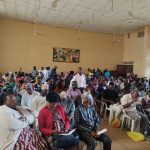
In attendance were traditional rulers, community leaders heads of various government parastatals, youth leaders as well as the general public.
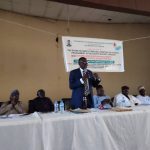
In a speech delivered by MR. LAMBA PETER BOT the permanent secretary of the ministry welcomed everyone to the occasion and stated that he cannot over-emphasise the importance of such a special interface between the Government and its citizens in the budgeting preparation process.
He further stated that it is a fact that the country’s dependable source of income has fallen as a result both government and the citizens are expected to look inward and find a new way of generating income and only then will Government be able to fulfil it’s duties to citizens.
SPEECH DELIVERED BY THE PERMANENT SECRETARY MINISTRY OF BUDGET AND ECONOMIC PLANNING MR. LAMBA PETER BOT ON THE OCCASION OF THE TOWN HALL MEETING ON CITIZENS ENGAGEMENT IN THE BUDGETING PROCESS FOR THE CENTRAL ZONE HELD AT PLATEAU STATE POLYTECHNIC, JOS CAMPUS ON 30TH JUNE, 2022 Protocol
It is my singler honour and privilege to welcome you to yet another consultative forum. The importance of the day cannot be over emphasized as this marks a special interface between Government and its citizens in the budget preparation process. The rationale behind this town hall meeting is to strengthen transparency, accountability and sustainability of government programmes as well as to gain government confidence in implementation.
Worthy of mention also is that, the citizens are the focal point of government budgeting policy and programmes hence the need for their involvement at the preparatory stage. Their valuable inputs is key in the process because they are part and parcel of the budget.
Ladies and gentlemen, you may recall that, we had a similar meeting on the subject matter where citizens were informed that government usually commenced the budget process by collecting proposals from the citizens of the state, all Ministries, Departments and Agencies (MDAs) and Civil Society Organizations (CSOs).
2023 citizen budget has to comply with a recent guideline that put emphasis on what is krown as local governance.
observing the guidelines put in place for total eradication of the menace so that our economic activities will strive more so that the country’s dependable source of income has fallen down. Consequently, with this development, both government and the citizens are expected to look inward or think outside the box.
Fellow participants, ladies and gentlemen, it is on this note that, I want to call on all citizens to contribute meaningfully during the discussion. As a government, we are fully aware of our obligation to the citizens but our challenges has always been the limited resources. However, we will not be deterred but remained focus to continue the struggle based on available resources.
It will interest you to note that, the ministry of budget and economic planning was directed to dropped the approved budget estimate of 147.5 billion naira in the 2021 fiscal year to 101 billion naira in 2022 which finally stood at 106.5 billionnaira after legislative consideration. The desire of government is to prepare a modest and realistic budget that will add value to the state not mere reflection of figures. I therefore, want to appeal for understanding of the citizens on that regard.
Finally, I want to commend the rescue team of this administration under the able leadership of his excellency, the executive governor of Plateau State and Chairman Northern governor’s forum, RT. Hon. Barr. Simon Bako Lalong for his tireless effort to transform and effect positive changes in the lifes of Plateau citizens despite all challenges. His leadership style of continuity and inclusiveness is highly commendable. Worthy of mention also is the relative peace he struggles for in the state. I therefore, charge all citizens to live in peace with one another irrespective of tribal or religious background.
Equally, it may interest you, to note that the 2023 budgeting process will soon commence following the same process which a budget draft document is expected to be transmitted to the legislature in good time. The projects and programmes to be encapsulated in the proposals are expected to be in lime with the three-pillar policy trust of our charismatic governor, RT. Hon. Barr. Simon Bako Lalong our rescue team leader, which are:
i. Peace, Security and good governance,
ii. Physical Infrastructure Development and
iii. Sustable Economic Re-BirthTherefore, your inputs at this meeting should be tailored towards supporting the above policies and also be in tune with the state development strategy which aims at improving our internally generated revenue (IGR).
Let me state here that, inspite of the limited resources, government is still responsive to its statutory responsibilities to the citizens of the state.
Indeed, to proof beyond reasonable doubt in governance, His Excellency, RT. Hon. Barr. Simon Bako Lalong has demonstrated by continued work on all the projects inherited from the past administration since inception with most of them now completed and very few un-going.
He has also initiated new projects that are very critical and have direct bearing on the lives of citizens cutting across the 17 local government areas of the state. Similarly, his desire and zeal for the welfare of citizens can be seen in the prompt payment of salaries and pension.
Let me use this opportunity to remind citizens that, the recent emergence of COVID-19 pandemic that affected our economy is still with us but gradually winding up. However, more needs to be done come
Once more, I welcome you all and wish you happy deliberation and journey mercy back to your destinations. STAY SAFE and may God bless you all. Thank you.
In response to questions and contributions made by the participants, Mr Lamba said that the budgeting process is a two-part process – Income (revenue) and Expenditure. Thus it is from the income that the government make budgetary allocations.
He also stated that Government have made a land provision for parking of trucks around Mararaban Jama’a junction to boost its revenue as well as solve the problems citizens face because of illegal parking of truck within the state.
He also states that the crisis in the state has affected the revenue generations from the tourism sector because investors shy away from coming to invest in the state.
Another highlight of the occasion is the presentation of the needs of the people by the Local Government Area leaders and their representatives to the permanent secretary. This was part of the initiatives of the CSO and the ministry.
Mr OJ Afwanks the co-chairman of the event and the representative of the Civil Society in the budget process. Stated that this partnership with Government is a welcome development that is bringing about a people-oriented budget, capturing the actual needs of the people.
The success of this event can be summarised with this three-point
The communities are actively engaged in the budgeting process
The approach of the budget is from the bottom to the top
The communities now have a working plan that they could hold on to.
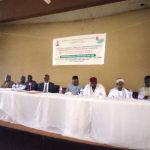
see Photos








Lingzhi Global Nigeria Ltd. has announced plans to hold the second edition of the Coffee Festival International Nigeria in Calabar, Cross River State, from October 30 to November 1, 2026, as part of efforts to promote coffee production and expand opportunities across the value chain.
The festival, organised in collaboration with the National Coffee and Tea Association of Nigeria, NACOFTAN, will be held under the theme, “Coffee Sustainability and Empowerment: Focusing on Women and Youth Development,” with emphasis on skills development, community development and job creation.

The Chief Executive Officer of Lingzhi Global, Mrs. Blessing Nanman, disclosed this at a stakeholders’ meeting in Abuja, saying the event would bring together coffee stakeholders, investors and international participants to explore opportunities in farming, processing, packaging, marketing and export.
“Farmers have gone to work. Some processors are already at the verge of breaking through. This is the time where we want to invite all investors, partners and international organisations to support us in the coffee industry,” Nanman said.
She said the maiden edition attracted participants from different countries, while the 2026 festival is expected to draw representatives from about 30 countries. According to her, the event would further define opportunities within the coffee value chain and encourage local consumption of coffee.
Nanman said Lingzhi Global was also expanding its coffee business through the establishment of coffee shops, noting that the outlets had become platforms where communities, families and people from different backgrounds could connect over coffee.

She said Cross River was selected to host the second edition because of its potential for coffee production and the state government’s efforts to expand cultivation through the distribution of millions of coffee seedlings.
Speaking on the forthcoming festival, Cross River State Commissioner for Agriculture and Irrigation Development, Hon. Johnson Ebokpo, commended Lingzhi Global for its role in promoting coffee and tea development in the state and for working with stakeholders to strengthen the sector.
He said the company had contributed efforts to improve farmers’ access to seedlings, knowledge and markets, describing its partnership with the state as important to the development of the coffee value chain.
“We are pleased to be collaborating with Lingzhi Global, organisers of the International Coffee Festival, and NACOFTAN,” Ebokpo said.
The commissioner said the festival would give Cross River greater visibility as a coffee-producing destination while creating opportunities for women and young people to participate in the industry.
“This is also an opportunity for us to use the festival as a platform to create jobs for our people, particularly women and youths, while providing them with opportunities to learn more and develop their skills,” he said.
Ebokpo said the coffee industry extends beyond farming to processing, packaging and export, stressing that young people could create businesses and develop their own brands by participating in different stages of the value chain.
He said Cross River has about 23,000 square kilometres of arable land suitable for coffee development and has the agro-ecological advantage of producing both Arabica and Robusta varieties. He added that the state plans to distribute at least 30 million coffee seedlings over five years.
President of NACOFTAN, Dr. Hassan Usman, said the festival would provide an opportunity for Nigerian stakeholders to exchange knowledge and technology with international players in the coffee industry.
“The Coffee Festival is not only Nigerian in inclusion, but international. We have people coming from Brazil, Indonesia, Kenya and all the countries. The globe will be around with us,” Usman said.
Usman also commended Lingzhi Global for taking stakeholders across the country and beyond to gain knowledge in coffee processing and marketing, saying the company had played a critical role in connecting Nigerian stakeholders with international opportunities.
He said stakeholders would use the gathering to strategise on strengthening the coffee value chain and changing the narrative around coffee production in Nigeria, while calling for greater participation from government agencies, investors and other stakeholders.
The 2026 Coffee Festival International Nigeria is expected to bring together farmers, processors, roasters, investors, experts and other stakeholders from Nigeria and abroad for three days of knowledge-sharing, networking and promotion of the coffee industry.


The streets of Jos echoed with a simple message on Saturday: peace is everyone’s responsibility.
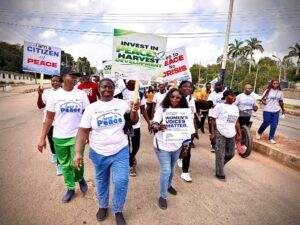
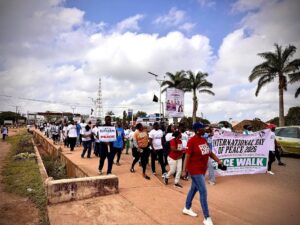
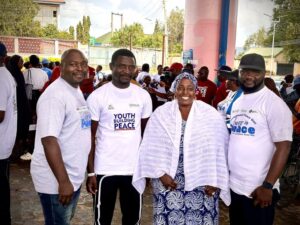
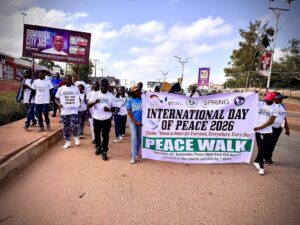
As part of activities marking the 2026 International Day of Peace, the Women for Positive Peacebuilding Initiative (WOPPI) joined other peace organisations for a peace walk from Old Airport Junction to Secretariat Junction Bridge.
Holding placards calling for unity, dialogue and peaceful coexistence, participants took the message of peace to the streets and into the public space.
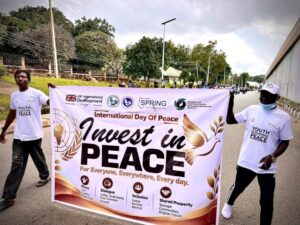
This year’s International Day of Peace, observed on September 21, is themed “Invest in Peace – For Everyone, Everywhere, Every Day.” The United Nations says the theme highlights the role of ordinary people as “everyday architects of peace.” (United Nations Peacekeeping)
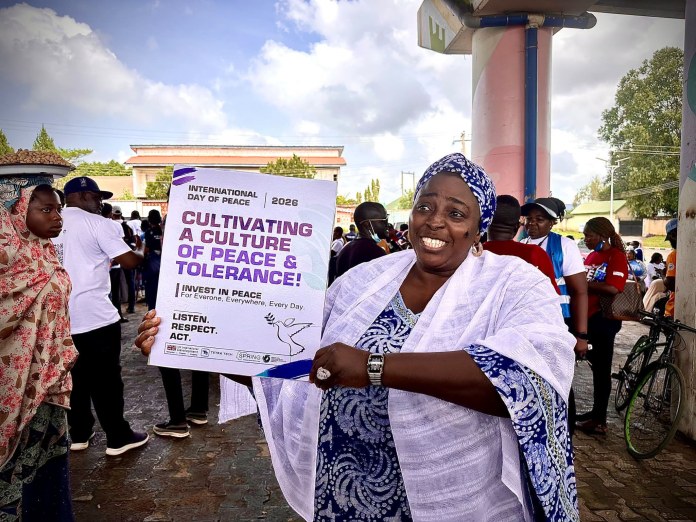
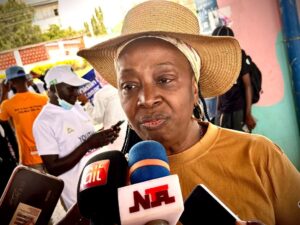
For WOPPI Executive Director, Lantana Abdullah, the message is particularly important for Plateau, a state with a history of violent conflicts.
She said peace cannot be left to government or security agencies alone. Every citizen, she stressed, has a role to play.
“Every citizen residing in Plateau or beyond Plateau or in Nigeria must play their part in making sure we sustain and build enduring peace for everyone.”
Abdullah urged citizens to choose dialogue over confrontation, report responsibly and speak up when they see issues capable of threatening peace.
She also challenged negative narratives about Plateau, pointing out that people continue to live, work and build their livelihoods across the state despite its troubled past.
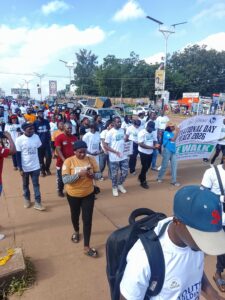
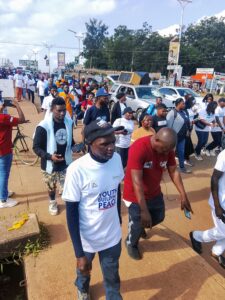
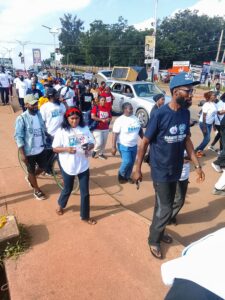
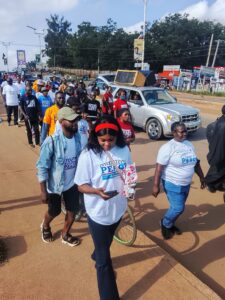
For WOPPI, women must also be at the centre of this process. The organisation works to strengthen women’s voices, train them as mediators and involve them in preventing and resolving conflicts within their communities.
The walk therefore carried more than placards. It carried a reminder: peace is not something people wait for others to create. It is something communities build—one conversation, one intervention and one peaceful choice at a time.
And in the words of this year’s global message, that investment must happen for everyone, everywhere, every day. (United Nations)
-

 Health4 days ago
Plateau: Medical Women Association of Nigeria Marks Older Persons Day with Free Outreach
-
News4 days ago
MTN, Gates Foundation drive $25m AI digital health plan in Nigeria – Technology Times
-
News4 days ago
WAEC appoints Nigeria’s Dangut as Registrar, CEO
-
Health4 days ago
Drug-resistant bacterial infections kill one million people annually – WHO