
News
Nigerian Army Warrant Officers Gather in Jos for Master Warrant Officer Promotion Challenge


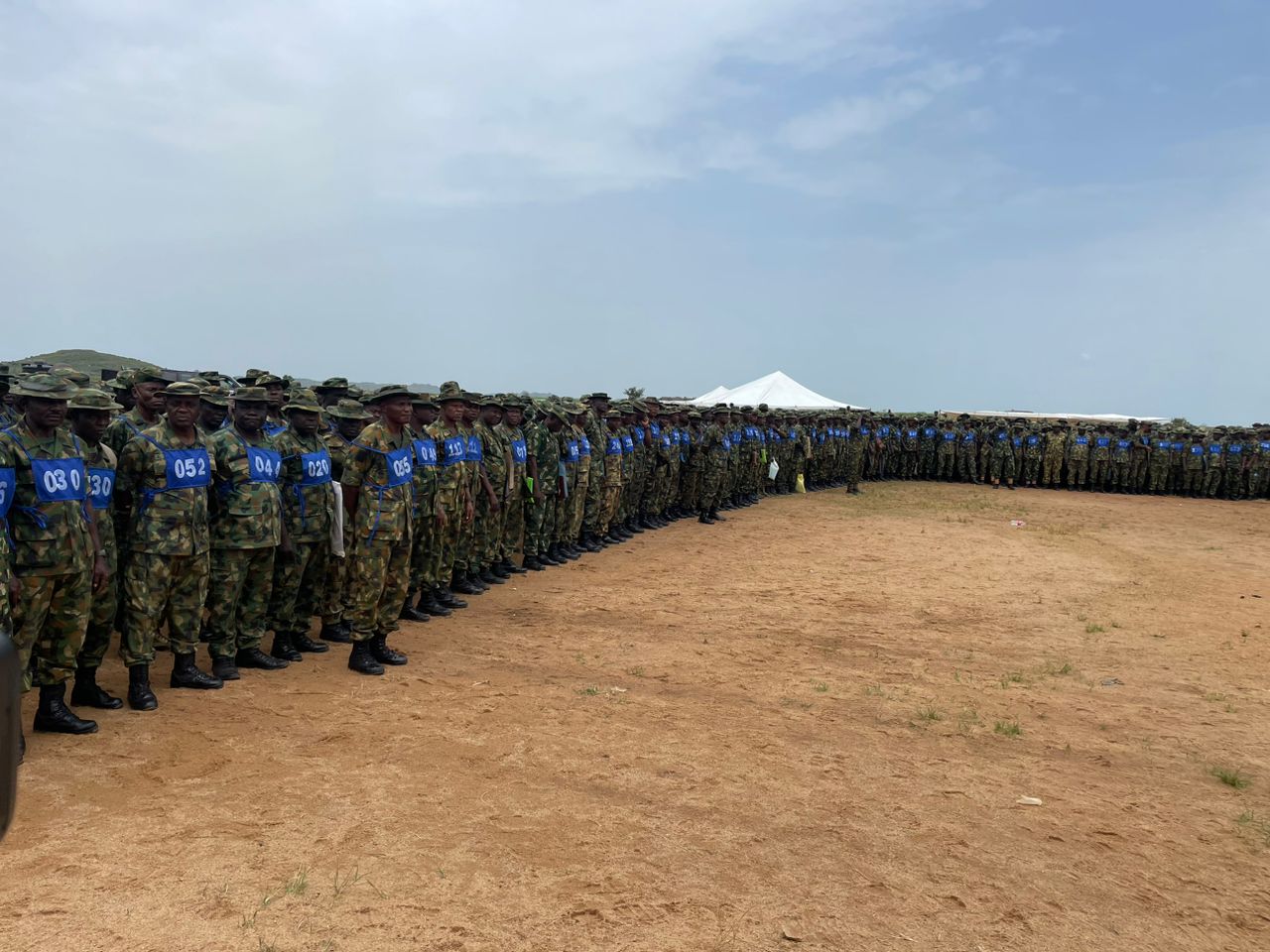
In a grand inauguration ceremony, the Nigerian Army gathered at the 3 Division Small Arms Range in Miango, Jos, on Tuesday, September 12, 2023, to kickstart the prestigious Warrant Officers to Master Warrant Officers Promotion Board for the year 2023.
Representing the Chief of Personnel Management (Army), Brig Gen A O Oyelade, Director of Personnel Planning at the Department of Personnel Planning, Nigerian Army Headquarters, opened the event. He warmly welcomed all attendees and expressed gratitude to the Chief of Army Staff, Lieutenant General TA Lagbaja, for facilitating this event in Jos. Acknowledging the logistical support provided by the host formation commander, Maj Gen AE Abubakar, to ensure the seamless execution of the exercise.

Brig Gen Oyelade urged all participants to put forth their best effort for a hitch-free exercise, emphasizing the rigorous evaluation process, including physical and medical examinations, personal drill, written examination, weapon handling, oral interviews, document screening, and basic computer knowledge for clerks. He reminded candidates that they must excel in all these areas to be eligible for promotion to Master Warrant Officer.
While encouraging competition among candidates, Brig Gen Oyelade stressed the importance of maintaining discipline, punctuality, abstaining from travel during the exercise, avoiding drug abuse, and refraining from using personal vehicles.
The General Officer Commanding 3 Division and Commander Operation Safe Haven, Maj Gen A E Abubakar, represented by Brig. Gen. Mohamed Kwamfut, Chief of Staff, 3 Division, in his remarks also welcomed attendees to the 3 Division Small Arms Range in Minago, Jos. He expressed his delight in hosting the Warrant Officer to Master Warrant Officer Promotion Board Exercise 2023.

Maj Gen Abubakar commended the Chief of Army Staff for providing the leadership and enabling environment for this significant event. He highlighted the exercise’s importance as a requirement for promotion to the esteemed rank of Master Warrant Officer and praised the dedication, professionalism, and commitment of the candidates to serve Nigeria.
He emphasized that the journey to becoming a Master Warrant Officer is demanding, requiring discipline, perseverance, and a profound understanding of the responsibilities attached to the rank. Maj Gen Abubakar assured the candidates that they would undergo a rigorous selection program designed to test their leadership and technical skills in line with the Chief of Army Staff’s command philosophy.
Maj Gen Abubakar reminded candidates that promotion to Master Warrant Officer signifies exceptional performance and trust in their capabilities. He expressed gratitude to the Board Members for their efforts in developing the program and ensuring fairness throughout the exercise.
He assured candidates of a comfortable stay during the exercise while emphasizing the importance of staying within designated areas for their safety.
In conclusion, Maj Gen Abubakar wished all warrant officers a successful promotion exercise, filled with a sense of achievement.
Brig Gen Oyelade officially declared the Warrant Officer to Master Officer Promotion Board 2023 open on behalf of the Chief of Army Staff, The inauguration ceremony marked the beginning of a three-week-long evaluation process that will determine the next group of Master Warrant Officers in the Nigerian Army.



The Minister of Aviation and Aerospace Development, Festus Keyamo, has directed the Nigeria Civil Aviation Authority (NCAA) to notify local and international airlines to place 46 people who had contact with Nigeria’s confirmed Ebola patient on a no-fly list for at least 21 days.
Mr Keyamo disclosed this on Wednesday after a virtual meeting with the Coordinating Minister of Health and Social Welfare, Muhammad Ali Pate, to discuss measures to contain the outbreak.
He said the list comprised 44 people who came into contact with the infected woman at a hospital after she developed symptoms, as well as two members of her domestic staff.
The minister said efforts were ongoing to isolate the individuals while health authorities determined whether they had contracted the virus.
He said he had directed the NCAA to notify all domestic and international airlines of the restriction immediately.
Airport surveillance intensified
Mr Keyamo also directed the Federal Airports Authority of Nigeria (FAAN) to strengthen Ebola surveillance and response measures at all international airports in the country.


According to him, measures being implemented include enhanced health screening, temperature checks, tracking of travellers’ histories, digital health declarations and coordination with the Nigeria Centre for Disease Control and Prevention (NCDC).
He said the measures followed earlier alerts about Ebola outbreaks in the region.
ALSO READ: Ebola: Nigerian govt assures citizens of containment strategies
Nigeria confirmed its first Ebola case in the Federal Capital Territory on Tuesday, prompting contact tracing and other containment measures.
The patient, a woman who recently arrived in Nigeria on an international flight from Uganda, is receiving treatment in isolation at a private hospital in Abuja.
PREMIUM TIMES reported that health authorities identified 44 close contacts of the patient and began tracing people who may have been exposed to the virus.
The 21-day restriction ordered by Mr Keyamo is intended to prevent the identified contacts from travelling by air during the period in which symptoms may develop.
Ebola virus disease can cause severe illness and is transmitted through direct contact with the blood or other bodily fluids of an infected person, or contaminated materials. Its incubation period typically ranges from 2 to 21 days.
Discover more from Premium Times Nigeria
Subscribe to get the latest posts sent to your email.
Lotus Bank has warned employees against entering confidential, personal or customer information into unapproved artificial intelligence (AI) tools, cautioning that the growing workplace adoption of the technology could expose sensitive data to privacy and cybersecurity risks.
The warning was delivered Wednesday during the Lotus Bank 2026 Cybersecurity and Data Privacy Awareness Webinar, where participants were advised to use approved AI platforms for organisational work, verify AI-generated outputs and maintain human oversight over consequential decisions.
“Do not enter confidential, personal or client information into unapproved AI services,” the webinar presentation stated. The guidance highlights the need for organisations to balance the productivity benefits of AI with safeguards for customer information, business records and other sensitive data.
AI tools can help employees draft documents, analyse information, generate code and automate routine tasks. However, submitting confidential material to services that have not been approved by an organisation can create risks involving data handling, retention, access and potential disclosure.

AI tools can help employees draft documents, analyse information, generate code and automate routine tasks. However, submitting confidential material to services that have not been approved by an organisation can create risks involving data handling, retention, access and potential disclosure.
Lotus Bank: AI creates new cybersecurity challenges
Beyond the risks associated with employees’ use of AI tools, the webinar identified the technology as one that cybercriminals could exploit to strengthen their attacks.
According to the presentation, attackers may use AI to generate convincing phishing messages, impersonate individuals through synthetic media, produce misleading content and create insecure code. These capabilities can make it more difficult for employees and customers to distinguish legitimate communications from fraudulent requests.
The presentation warned that modern phishing attacks could involve personalised messages, convincing branding, impersonation of executives, colleagues or suppliers, fake login pages, malicious attachments, and fraudulent requests delivered through voice calls and messaging applications.
It also cautioned against relying on spelling and grammatical mistakes alone to identify phishing attempts, noting that fraudulent messages can appear professional and convincing.
Lotus Bank employees were advised to examine senders’ identities, consider whether they were expecting a communication, inspect links before opening them and verify unusual requests through established, independent channels.
The presentation placed particular emphasis on checking requests involving login credentials, verification codes, confidential information or payments before taking action.
“Trust should never replace verification when money, access or sensitive information is involved,” the presentation stated.
The advice underscores the importance of combining technical security controls with employee awareness, particularly when attackers exploit trust and urgency to persuade victims to bypass established procedures.
Employees urged to safeguard customer information
The webinar also stressed that having access to information does not automatically give employees permission to disclose, copy or transfer it.
Participants were advised to share sensitive information only with authorised recipients, verify recipients before sending files, and use approved storage and transfer platforms.
The presentation further recommended restricting access appropriately, complying with information-retention requirements and securely disposing of records when they are no longer needed.
Employees were cautioned against using personal accounts or unapproved tools to handle business information and urged to report misdirected communications and suspected data exposure promptly.
The guidance covers customer and employee personal information, financial and payment details, business plans, contracts, intellectual property, security configurations and confidential operational records.
These safeguards are particularly relevant to financial institutions, where employees routinely handle sensitive customer information and exchange documents with customers, suppliers and other external parties.
During the question-and-answer session, a participant raised concerns about relationship managers and other employees who receive files from customers and business partners, noting that malicious attachments could infect devices and potentially expose organisational information.
In response, Sodiq Bello, the bank’s chief information security officer, said the institution had measures in place to protect files and information received from customers and other external parties.
Bello also advised employees who handle such information on personal devices to activate available security features and consider endpoint protection, including antivirus software.
He urged staff to exercise caution before accepting, downloading or installing files received from others.
Employees, he explained, should verify senders’ identities and establish whether a communication or file-sharing request is consistent with their previous interactions.
Bank stresses responsible AI use and access controls
The webinar’s recommendations extended beyond AI applications to broader cybersecurity practices, including identity protection, access management and the remediation of technical vulnerabilities.
Employees were advised to use strong, unique passwords, enable multi-factor authentication where available or required, reject unexpected authentication prompts, and avoid sharing passwords or one-time verification codes.
Organisations were also urged to restrict access to sensitive systems according to employees’ responsibilities, regularly review privileged accounts and remove access when it is no longer required.
The presentation warned that outdated software, unsupported systems, weak configurations, exposed remote-access services and inadequately protected backups could create opportunities for attackers.
It also discouraged employees from bypassing security controls for convenience, installing unapproved software, sharing credentials to save time or sending sensitive files through unauthorised channels. Where security controls interfere with legitimate work, employees were advised to seek authorised support rather than create unofficial workarounds.
The bank’s presentation further urged employees to report suspected incidents promptly. These include clicking suspicious links, opening unexpected attachments, sending information to the wrong recipient, approving unauthorised authentication requests and noticing unusual account activity.
Employees were advised to stop the affected activity, report the incident through approved cybersecurity channels, preserve relevant information and follow instructions from authorised incident responders.
During the question-and-answer session, Dr. Olufemi Obadare, associate director and chief project manager at Digital Encode Limited, who addressed participants on employee security practices, urged workers to make cybersecurity awareness a continuous activity rather than treating it as a one-off exercise.
Obadare advised employees to pause and assess requests before acting, particularly as cybercriminals continue to change their tactics and exploit emerging technologies.
The webinar concluded with a call for employees, management, developers, system owners and business partners to make cybersecurity and data protection part of their everyday responsibilities. It also encouraged organisations to address security weaknesses, hold employees and partners accountable, and learn from incidents to improve their defences.
The central message was that protecting information requires more than deploying security technologies. It also depends on responsible employee behaviour, appropriate controls and the careful use of AI tools when handling sensitive information.
-

 News3 days ago
Euromatch NPFL: Matchday 9 results
-
News3 days ago
No agenda, no rush, no leaving San Francisco: Benchmark’s partners on investing in a frenzied market
-
News3 days ago
Amazon to fund 12 small nuclear reactors at former Indiana coal plant
-
News2 days ago
Mamdani says feds have abdicated on AI, urges New Yorkers to push back