News
MTN Challenges Nigerians: Compare our data prices with Kenya, South Africa, Zimbabwe – Technology Times

MTN Nigeria has challenged Nigerians to compare mobile data prices with those in other African countries before concluding that internet access is more expensive in Nigeria, as the nation’s leading mobile operator pushes back against persistent complaints over the cost and rapid depletion of data bundles.
Karl Toriola, CEO of MTN Nigeria, said consumers should examine the prices of comparable data bundles in Kenya, South Africa and Zimbabwe before reaching their own conclusions about the affordability of mobile internet services in Nigeria.
Speaking on Monday at MTN’s Data on Trial event held in Abuja, Toriola urged consumers to visit the websites of telecoms operators in those countries, including Safaricom in Kenya, Vodacom in South Africa and Econet in Zimbabwe, to compare the cost of different data packages.

“Don’t trust me. Go to other African countries before you get to Europe and check for the price of 1GB, 5GB, 10GB of data yourself and form your own opinion around it,” he said. The MTN Nigeria CEO challenge comes amid continuing public concerns about the affordability of mobile internet access and complaints from subscribers who say their data allowances disappear faster than expected, sometimes when they believe they have barely used their phones.
MTN Nigeria CEO wants consumers to examine comparable information on mobile internet costs
He specifically encouraged Nigerians to examine 1GB, 5GB, 10GB and 20GB bundles rather than rely on general perceptions about the cost of internet access. “The perception that data in Nigeria is expensive is wrong,” Toriola said.
The MTN Nigeria chief executive said the exercise would allow consumers to assess the company’s position using comparable information rather than simply accepting its claims without verification.
“Don’t trust me. Go to other African countries before you get to Europe and check for the price of 1GB, 5GB, 10GB of data yourself and form your own opinion around it,” he said.
The MTN Nigeria CEO challenge comes amid continuing public concerns about the affordability of mobile internet access and complaints from subscribers who say their data allowances disappear faster than expected, sometimes when they believe they have barely used their phones.
MTN points to Nigeria’s high telecom operating costs
Toriola argued that the cost of operating telecoms infrastructure in Nigeria should be taken into account when comparing local data prices with those in other markets.
According to him, Nigerian operators face substantial expenses providing electricity and transmission services to network sites, with diesel costs adding to the financial burden of maintaining reliable connectivity.
He said these operating conditions differ from those in European countries that are sometimes used as benchmarks for comparing mobile data prices.
Toriola disclosed that MTN spent about N1.05 trillion on power in the previous year, before a subsequent increase in diesel prices linked to the crisis around the Strait of Hormuz.
“We spent about 1.05 trillion Naira last year on power only,” he said. The figure highlights the energy costs MTN says contribute to the expense of running its telecoms infrastructure in Nigeria.
Toriola also said Nigerian operators purchase network equipment supporting fourth-generation (4G) and fifth-generation (5G) services from international suppliers using the same foreign currencies as operators in other markets.
He further pointed to the technology underpinning telecoms billing systems, saying MTN uses Ericsson as its billing system vendor, with similar systems deployed by operators in Western markets.
However, Toriola added, comparing advertised data prices across countries requires more than looking at the headline cost of a bundle. Bundle sizes, validity periods, taxes, exchange rates, average incomes and purchasing power can all affect the relative affordability of internet access.
A lower or higher advertised price alone, therefore, would not establish how much of their income consumers in different countries must spend to remain connected.
Why MTN says data bundles can disappear quickly
MTN’s defence of its pricing was accompanied by explanations from its network and information technology executives about how smartphone settings, video streaming and background applications can contribute to data consumption.
Michael Ndukwe, General Manager, Network Performance and Quality Assurance at MTN, said the growing use of social media and video-based applications has increased demand for mobile data.
He cited figures showing that Nigeria recorded 13.2 million terabytes of data traffic in 2025, while 8.52 million terabytes were recorded in the first half of 2026. Ndukwe described the figures as representing roughly 43% year-on-year growth, although the comparison period for that calculation was not specified in the presentation.
He identified TikTok, YouTube, Facebook, Instagram, WhatsApp and X among the major social media platforms contributing to data usage in Nigeria.
According to him, the amount of data consumed when watching videos depends significantly on their resolution.
He said a 15-second TikTok video can consume approximately two to three megabytes in standard definition, while the same video could use as much as 15 megabytes in high definition. Automatic playback can also increase consumption because another video may begin loading as soon as the previous one finishes.
WhatsApp users may also consume substantial amounts of data through status videos, automatically downloaded media, files shared in groups and chat backups to cloud storage, Ndukwe said.
He advised subscribers to disable automatic media downloads where appropriate, reduce video quality and restrict backups to Wi-Fi networks to avoid unnecessary mobile data consumption.
MTN tells subscribers to monitor their data
Toriola said MTN’s Data on Trial initiative is intended to help customers understand their consumption patterns and examine complaints about disappearing data bundles. He recounted an instance involving a senior MTN employee who suspected the company was taking her data after a large quantity disappeared overnight.
According to Toriola, an examination of the employee’s phone revealed that WhatsApp was backing up data every night. The incident, he said, illustrates how background activity can consume substantial amounts of data without users being fully aware of it.
David Ogunshola, General Manager of IT Operations at MTN Nigeria, also explained that figures displayed on smartphones may differ from network records because devices and telecoms networks can measure or present data consumption differently.
MTN recommends that subscribers use the MyMTN app to monitor real-time data usage and alerts, alongside the data-management tools available on their smartphones.
The operator also promotes its fibre broadband service, MTN FiberX, as an option for customers with high data requirements.
While these measures could help subscribers identify sources of data consumption, the explanations do not independently establish whether every customer complaint about data billing is justified. For consumers, the central questions remain whether the data deducted corresponds accurately with their usage and whether available bundles provide reasonable value for money.
MTN’s challenge to Nigerians to compare prices across African markets has therefore placed its affordability claim up for public scrutiny. For such a comparison to be meaningful, consumers would need to examine equivalent bundles, validity periods, taxes and purchasing power across the different markets.
The debate is consequently no longer only about how much a gigabyte costs. For millions of Nigerian subscribers, the bigger question is how much useful connectivity they actually get for the money they spend.




The African Democratic Congress, ADC, has threatened to take its planned campaign rally to the streets of Kaduna after the state government refused to grant it access to Ranchers Bees Stadium.
The opposition party accused the Kaduna State Government of deliberately frustrating its political activities by denying it the use of the stadium for its scheduled rally on November 17 and 18, 2026.
The ADC disclosed this in a press statement issued on Tuesday by its National Publicity Secretary, Mallam Bolaji Abdullahi.
According to the party, it had earlier applied to the state government for permission to use the stadium but was denied approval in a letter dated November 12 by the Ministry of Local Government.
The ministry reportedly attributed the refusal to ongoing renovation work at the facility.
However, the ADC questioned the explanation, noting that the ruling All Progressives Congress, APC, had used the same stadium to flag off its presidential campaign on October 24, barely three weeks earlier.
The party described the government's explanation as ridiculous, alleging that the APC was afraid of the large crowds attracted by its rallies across the North.
“We find the excuse quite ridiculous. This was the same stadium where the APC flagged off its presidential campaign on October 24. But we know what they are afraid of,” the statement said.
The ADC further alleged that the government was attempting to prevent residents from comparing the attendance at its rallies with that of the ruling party.
Insisting that it would not abandon its planned rally, the opposition party threatened to hold a street demonstration if the government continued to deny it access to the stadium.
“If the Kaduna State Government will not allow us to campaign peacefully in the stadium, we will exercise our constitutional right to assemble peacefully in the streets.
“You may deny us a venue, but you cannot deny Nigerians their constitutional right to peaceful assembly,” the party said.
The ADC maintained that public facilities should not be used as instruments of political exclusion, arguing that they belong to the people regardless of the political party controlling the government.
It also warned that denying opposition parties access to public infrastructure amounted to violating citizens' rights to peaceful assembly and democratic participation.
The party urged the Kaduna State Government to reconsider its position, citing the Bauchi and Yobe state governments as examples of administrations that had allowed opposition parties to carry out their political activities.
2027: Deny us stadium, we’ll take over your streets – ADC tells Kaduna govt

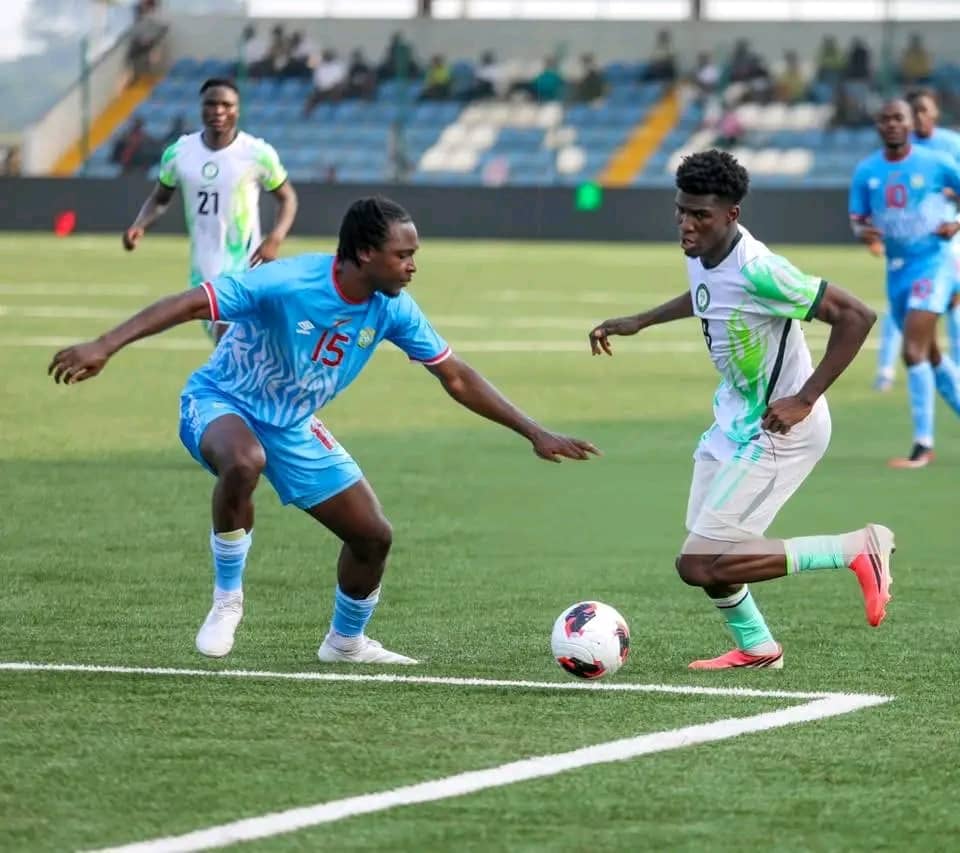
Nigeria’s Olympic Eagles have produced a sensational comeback to defeat DR Congo 4-0 in the second leg of their U23 Africa Cup of Nations (AFCON) qualifying tie, securing a 4-2 aggregate victory and keeping their qualification campaign alive.
After suffering a disappointing 2-0 defeat in the first leg, the Nigerian side responded emphatically at the Remo Stars Stadium in Ikenne, delivering an outstanding performance to overturn the deficit and advance to the next stage.
Alex Oweilayefa set the tone for Nigeria’s remarkable comeback when he opened the scoring in the 8th minute, reducing DR Congo’s aggregate advantage and giving the home supporters renewed belief.
The Olympic Eagles continued their attacking momentum after the restart, with Peter Edokpolor doubling Nigeria’s lead in the 47th minute to level the aggregate score at 2-2.
Samuel Victor then struck in the 57th minute, completing Nigeria’s turnaround and putting the hosts ahead on aggregate for the first time in the tie.
With DR Congo struggling to contain Nigeria’s attacking pressure, the Olympic Eagles maintained their intensity and discipline as the contest approached its conclusion.
The decisive moment arrived deep into stoppage time when Muiz Adeleke converted a penalty in the 90+4th minute to seal a commanding 4-0 victory on the night.
The result completed an extraordinary turnaround for Nigeria, who progressed with a 4-2 aggregate triumph after entering the return fixture with a two-goal deficit.
The victory represents a significant statement from the Dream Team, whose response demonstrated resilience, attacking quality and determination under pressure.
Following their impressive comeback, Nigeria will now turn their attention to Zambia, whom they are scheduled to face in May 2027 in the next stage of the qualification campaign.
The Olympic Eagles will be aiming to maintain their momentum and build on the confidence gained from their emphatic victory over DR Congo.
For Nigerian football supporters, the night in Ikenne will be remembered for a remarkable comeback that showed the fighting spirit of the nation’s U23 side.
From a 2-0 first-leg setback to a stunning 4-0 triumph — the Olympic Eagles have answered in style!
-

 News4 days ago
Every ₦1 spent on advertising generates ₦16.50 in Nigeria’s GDP, ARCON says – Technology Times
-
News3 days ago
Tinubu (APC) in Jos: Promises to restore peace in the State and Nigeria
-
News3 days ago
Heavy Security as Tinubu Takes Campaign to Jos
-
News3 days ago
Yari Defends Tinubu on Insecurity, Says Opposition Failed to Tackle Crisis for Over 20 Years