News
International Press Centre Trains Journalists to Combat Information Disorder in Democratic Governance Reporting

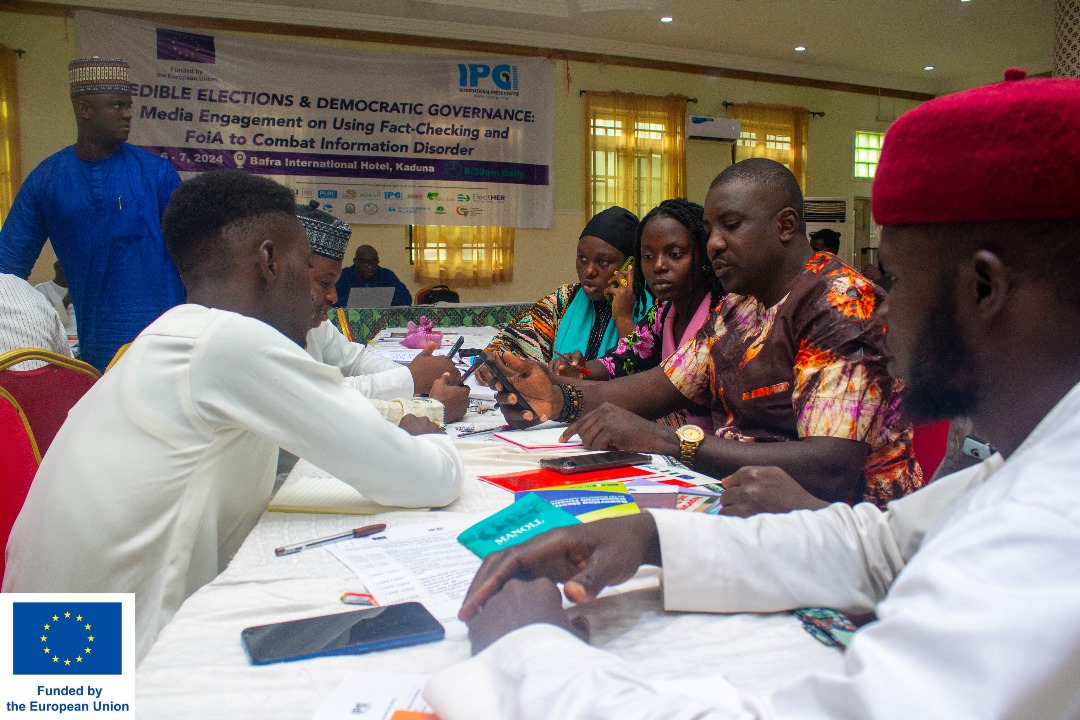
The Lagos-based International Press Centre (IPC) conducted a comprehensive training program for 40 journalists aimed at combating information disorder in democratic governance reporting. The two-day workshop took place in Kaduna State on Wednesday, March 6th, and Thursday, March 7th, 2023, drawing participants from nine states across Northern Nigeria.
Journalists from various Northern states, including Abuja, Kaduna, Kastina, Niger, Bauchi, Jigawa, Kano, Plateau, and Benue, participated in the workshop. These journalists, spanning different levels of experience from new to mid-level, community, and freelance journalists, converged to enhance their skills in combating misinformation and promoting transparency in democratic governance reporting.
The workshop, part of the European Union Support to Democratic Governance in Nigeria (EU-SDGN) project, focused on utilizing fact-checking and Freedom of Information (FOI) tools. With the theme “Credible Elections and Democratic Governance: Media Engagement on Using Fact-Checking and FOIA to Combat Information Disorder,” the training underscored the critical role of media engagement in ensuring transparent electoral processes and countering the spread of misleading information.
Stella Nwofia, the Programme Manager of IPC, addressed participants at the training session held at the Bafra International Hotel in Kaduna. She emphasized the significance of the training in addressing the growing threat of misinformation to democratic governance. Nwofia highlighted the training’s alignment with the EU final report of the 2023 general elections, aiming to equip journalists with the necessary tools, skills, and knowledge to navigate the challenges of the digital era while upholding standards of responsibility and ethical behavior.
“This training program is designed as a three-part series to empower journalists nationwide, promote critical thinking, fact verification, and media literacy,” said Ms. Nwofia. “Our goal is to empower journalists to uphold truth, advocate integrity, and safeguard democracy.”
The event featured lecture sessions by distinguished speakers, including Lanre Arogundade, the Executive-Director of IPC, who spoke on the principles of good journalism and the importance of fact-checking. Edetean Ojo, Executive Director of Media Rights Agenda, delivered a lecture on utilizing the FOI Act and investigative methodologies to report on democratic governance and electoral accountability issues.
During the training, participants engaged in practical exercises on information verification and fact-checking under the guidance of Mr. Arogundade. Dr. Fatimah V. Shuaibu from the Department of Mass Communication at Kaduna Polytechnic addressed the gender dimension in combating information disorder, emphasizing the significance of diverse perspectives in media reporting.
Mr. Edetaen Ojo highlighted the essential role of the FOIA in investigative journalism, urging participants to leverage this legislative tool to hold government and corporate bodies accountable.
The training provided by the EU and IPC serves as a critical step in equipping journalists with the skills and knowledge needed to combat fake news and promote accountability in Nigeria. By fostering a culture of transparency and responsible journalism, journalists play a pivotal role in strengthening democracy and ensuring a brighter future for all Nigerians.











Ibom Raptors made an impressive start to SHOWTIME Bowl Series XV, defeating Lagos Greenbacks 21-12 at Showtime Arena on Sunday as another competitive chapter of Nigeria’s professional flag football league got underway.
The final score tells only part of the story. The contest produced momentum swings, defensive stops and several opportunities for both teams, but the Raptors ultimately found the execution required to secure their opening victory.
Quarterback Taiwo Oluwalanu was at the heart of the Raptors’ performance and finished with the team’s highest player rating of 7.5. He consistently moved the offence downfield and connected with his receivers in serious situations, including touchdown combinations with Titilayo Happiness Abanikanda as Ibom turned pressure into points.
The player ratings also highlighted contributions beyond the quarterback position. Aisha Raji Oluwatosin earned 7.0, Moyosore Adolphus recorded 6.6, while Billie Oyebanji Anuoluwapo finished on 6.3, reflecting the collective effort behind the victory.
Lagos Greenbacks had their own standout performer in Precious George, whose 7.6 rating was the highest displayed across the two teams. Her defensive influence included several pass break-ups as Greenbacks battled to stay in the contest. Emmanuel Ojirinnaka also impressed with a 7.0 rating, while Philip Osakwe and Divine Chidera both recorded 6.6.
For SHOWTIME, the growing emphasis on detailed player ratings adds another dimension to Series XV. Fans are no longer following only wins and losses; individual performances can now be tracked, compared and discussed throughout the season, giving emerging athletes greater visibility and creating additional storytelling opportunities for commercial partners.
That visibility matters as SHOWTIME continues building a professional sporting product around its players. Every touchdown, interception, defensive play and standout rating can help transform previously unfamiliar names into recognisable sporting personalities.
For the Raptors, however, the immediate prize is the result. They have opened Series XV with a victory and valuable early momentum.
Ibom Raptors have landed the first blow — and Taiwo Oluwalanu has given SHOWTIME fans another name to watch.
-

 Business19 hours ago
Lingzhi Global, NACOFTAN Announce 2026 Coffee Festival in Cross River
-
News4 days ago
Tinubu’ll win presidency with 65 percent votes – Jibrin
-
News3 days ago
Crusoe raises $3.9B to build massive data centers and small modular “AI factories”
-
Events19 hours ago
Peace Walk: WOPPI Urges Plateau Citizens to Invest in Peace Every Day