Business
First HoldCo appoints new non-executive director


First HoldCo Plc has appointed Gwen Mwaba as a non-executive director of the financial institution, effective 15 October, following an approval by the Central Bank of Nigeria (CBN).
The lender disclosed the appointment in a regulatory filing signed by Abiola Baruwa, the group company secretary, on Thursday.
First HoldCo said the appointment was made in accordance with the Nigerian Exchange Limited (NGX) Rulebook.
According to the lender, Ms Mwaba brings significant expertise in corporate governance and board oversight, credit risk and portfolio management, banking strategy, capital deployment, structured trade and commodity finance, development finance, environmental, social and governance (ESG) issues, and emerging-market risk.
Profile
Ms Mwaba brings nearly three decades of experience in global banking and development finance institutions, with particular expertise in credit risk oversight, portfolio governance, corporate and sovereign lending, structured trade and commodity finance, development finance and emerging markets.
Until recently, she served as managing director of Trade Finance and Correspondent Banking at the African Export-Import Bank (Afreximbank), based in Cairo, Egypt.


In that role, Ms Mwaba had executive leadership responsibility for trade finance and structured credit activities across Africa and the Caribbean.
The newly appointed director also oversaw a $19.5 billion portfolio of sovereign, financial institution and corporate exposures.
She contributed to the bank’s Pre-Credit and Credit Committees, providing senior credit judgement on major lending transactions. She also oversaw portfolio strategy, sector exposures and country risk limits.
Before that, Ms Mwaba served as regional head for Anglophone West Africa at Afreximbank, overseeing regional strategy and credit origination across Nigeria, Ghana, Sierra Leone, Liberia, The Gambia and Cape Verde.
Earlier, she was executive vice president of Structured Trade and Commodity Finance at Standard Bank Plc, London, where she was responsible for complex commodity finance, export credit agency-backed facilities and pre-export financing transactions across Africa.
Her earlier banking career included senior roles at Stanbic Bank Zambia and Standard Bank South Africa, including head of Vehicle and Asset Finance and head of Corporate Banking.
READ ALSO: CBN restates single-digit inflation target as FG woos investors with tax credits
Ms Mwaba’s wider industry experience includes membership of the editorial board of Trade Treasury & Payments.
Until recently, her also served on the Multilateral Institutions Board Advisory Panel of the International Trade and Forfaiting Association (ITFA) and the World Trade Organization-led Expert Group on Trade Finance.
Ms Mwaba holds a Master of Business Administration (MBA) from Heriot-Watt University, United Kingdom, and a Bachelor of Science (Honours) degree in Applied Accounting from Oxford Brookes University, United Kingdom.
She is a Fellow of the Association of Chartered Certified Accountants (FCCA) and holds a professional qualification from the Chartered Institute of Transport.
Discover more from Premium Times Nigeria
Subscribe to get the latest posts sent to your email.




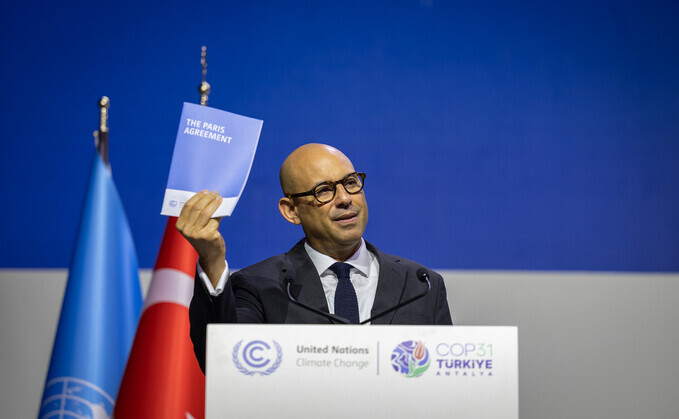
The executive secretary of UN Climate Change, Simon Stiell, told the ministers at COP31 that climate finance must be redesigned to lift developing countries out of a cycle of debt and disaster, adding that meeting a headline figure will not do it.
“Meeting a financial target does not always meet countries’ needs. To do that, we need to look at how finance is delivered,” Mr Stiell said on Friday at the opening of a high-level ministerial dialogue on climate finance in Antalya, Turkey.
Countries agreed at COP29 that developed nations would lead in providing $300 billion a year by 2035, as part of a wider effort to raise $1.3 trillion annually from all sources.
Mr Stiell said the roadmap for reaching those sums “must become reality”, but that the terms of the money mattered as much as the amount.
“Many developing countries are trapped in a downward loop of debt, disaster, and devastating capital costs,” he said. “The threat of floods, fires, storms and droughts hangs over them, pushing up the price of borrowing even before disaster strikes.”
He stated that the terms of finance should reflect each country’s debt position.
“Private finance, loans and guarantees are essential to achieving our collective goals. But grant-based and highly concessional finance will remain critical, particularly for Least Developed Countries, Small Island Developing States and other very vulnerable economies,” he said.
According to him, broader action on debt is also needed to prevent countries from being forced to choose between repayments and resilience.
International climate finance for developing countries reached about $137 billion in 2024, and almost 70 per cent of it came in the form of loans, according to a UN Women flagship report released on Tuesday in Antalya.
Countries in sub-Saharan Africa paid more than twice as much in external debt service between 2021 and 2023 as they received in climate finance, according to an analysis published by the Heinrich Böll Foundation.
The analysis found that interest payments consumed more than 10 per cent of government revenue in 27 African countries in 2024.
The chair of the African Group of Negotiators, Nana Antwi-Boasiako Amoah, has said that a transition could not be called just if poorer countries have to “mortgage their futures” to pay for it.
The group lost a bid on Monday for a separate agenda item on tripling adaptation finance. It now wants the target prioritised in the summit’s cover decision.
Nigeria is not on the UN’s list of least developed countries, which places it among the states the UN climate chief expects to rely more on loans, guarantees and private capital.
It needs about $337 billion between 2026 and 2035 to implement its climate commitments, according to the National Council on Climate Change.
Omotenioye Majekodunmi, the agency’s director-general, said more than 80 per cent of that will have to come from private investment, commercial debt, and international carbon finance.
About $2.5 billion a year went to climate action in Nigeria in 2021 and 2022, counting domestic and international sources, according to the Climate Policy Initiative’s tracking.
The dialogue was the last in a series that began in 2013, and its conclusions will go to COP32 in Ethiopia next year, Mr Stiell said.
Discover more from Premium Times Nigeria
Subscribe to get the latest posts sent to your email.
-

 News4 days ago
APM holds Presidential Campaign in Plateau, Pledges Security and Economic Reset
-
News1 day ago
UNIJOS Appoints Patricia Lar as First Female Vice-Chancellor
-
News3 days ago
NiYA: Nigeria Awards ₦49m grants to 17 young entrepreneurs – Technology Times
-
News4 days ago
NPFL Matchday 12 Roundup: Rangers Edge Kwara United, Bendel Snatch Late Winner as Inter Lagos Rescue Derby Point