Connect with us

News

Mutfwang’s N15 Billion Loan: Plateau APC Raises Alarm

editor

Published

on

Caleb Mutfwang

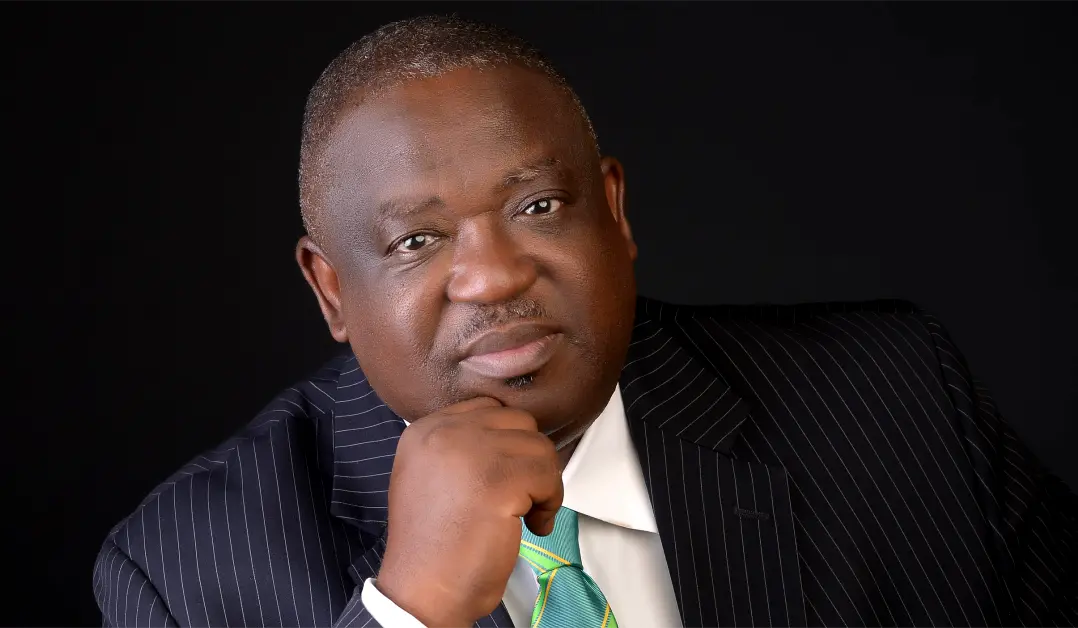
The Plateau State chapter of the All Progressives Congress (APC) has raised serious objections to the recent approval of a N15 billion loan by the Plateau State House of Assembly. The loan request, made by Governor Caleb Mutfwang, was granted in less than three weeks since the start of the People’s Democratic Party (PDP) administration in the state.

As a critical stakeholder in the Plateau project, the APC believes that this loan acquisition reflects the desperate and hasty nature of the PDP administration, which has shown little regard for due process and accountability.

The APC emphasizes that the two-thirds majority enjoyed by the Plateau State House of Assembly should not be seen as a license for recklessness and arbitrariness. If left unchecked, the state could face even more turbulent days ahead.

The reasons given for the loan are deemed unconvincing and untenable by the APC. Reports suggest that the funds will be allocated for recurrent purposes, such as salary payments and the purchase of fertilizer. The government claims that this loan is intended to demonstrate its concern for the welfare of striking workers and the farming community in the state.

However, the APC sees this as a mere facade and an attempt to deceive the people. The party argues that instead of installing Interim Administrators in the local governments to serve as conduits, the government has opted for the N15 billion loan to fulfill its extra-budgetary commitments.

According to the APC, government is a continuum, and the previous administration had already made adequate budgetary provisions for essential expenditures like workers’ salaries and fertilizers, considering the agrarian nature of Plateau State.

The approval of this N15 billion loan is particularly alarming because it violates the clearly outlined steps for loan acquisition as specified in the Plateau State Debt Management Law, which has not been repealed. These steps include the State Debt Management Advisory Committee’s discussion on the purpose and necessity of the loan for the state.

The APC highlights the importance of following due process and not operating as if under a military junta where decisions are made arbitrarily. For a loan of such magnitude, it is mandatory for the State Executive Council to approve it before submitting it to the House of Assembly for deliberation.

Furthermore, the approvals from the State Executive Council and the House of Assembly should be forwarded to the Ministry of Finance and the Debt Management Department for further processing, including seeking approval from the Debt Management Office and the Minister of Finance through the raising of an Irrevocable Standing Payment Order (ISPO).

The APC raises several important questions, including whether a State Executive Council is presently constituted in the state and if the Debt Management Advisory Committee has been established to discuss the loan based on the law. Additionally, concerns are raised about the state’s debt position in the future, considering the rapid acquisition of N15 billion within just three weeks, potentially leading to a debt of N720 billion in four years.

The APC questions why the same government that complains about a debt profile of N200 billion, which they misleadingly attribute to the immediate past administration, is eager to accumulate another substantial loan.

The APC concludes by urging the governor to exercise caution and be wary of certain advisers appointed to oversee critical institutions, such as the House of Assembly. The party suggests that immediate attention should be given to addressing pressing issues, particularly security, as the people of the state are continuously being killed and displaced by heartless murderers

Continue Reading
Click to comment

Leave a Reply

Your email address will not be published. Required fields are marked *

Business

Nigeria Targets $21 Billion Investment in Landmark Bonga Southwest Deal

info

Published

on

By

BYAGENCY REPORTERS —The Nigerian National Petroleum Company Limited (NNPC Ltd), and the OML 118 Contractor Parties  — Shell Nigeria Exploration and Production Company Limited (SNEPCo), Esso Exploration and Production Nigeria (Deepwater) Limited, and Nigerian Agip Exploration Limited (NAE) — yesterday executed the Addendum to the OML 118 Production Sharing Contract (PSC) and the Addendum to the Dispute Settlement Agreement (DSA), marking a major milestone in the advancement of the deepwater Bonga Southwest/Aparo  project (BWSAp) towards Final Investment Decision (FID).

The execution gives effect to the fiscal and commercial terms approved by the Federal Government to support the development of BSWAp and it reinforces Nigeria’s commitment to creating a competitive, stable and attractive environment for large-scale deepwater investment.

The milestone follows the approval by President Bola Ahmed Tinubu of the Deep Offshore Oil and Gas Projects Incentives (Tax Remission) Order, 2026, an important component of the Federal Government’s ongoing reforms to enhance the competitiveness of Nigeria’s deepwater sector and unlock new investment. The BSWA PSC and DSA Addenda demonstrate the practical impact of these reforms in translating policy into investment and project development.

BSWAp is expected to be one of Nigeria’s largest deepwater developments, with the potential to attract US$15 billion to US$21 billion in investment over the life of the project and achieve peak production of about 175 kbopd of oil and 140 mmscfd of gas. The development is expected to contribute significantly to Nigeria’s economy through increased oil and gas production, government revenues, foreign exchange earnings, local content development, employment and expanded opportunities for Nigerian businesses.

Speaking on the milestone, the Group Chief Executive Officer of NNPC Ltd, Engr. Bashir Bayo Ojulari, said: “The execution of the BSWAp PSC and DSA Addenda demonstrates the effectiveness of President Tinubu’s reforms in translating policy into investment. This is about unlocking a major deepwater project and demonstrating that Nigeria has a competitive fiscal framework and a clear pathway for sustainable investment in its energy sector. NNPC Ltd will continue to work closely with the Federal Government, our partners and other stakeholders to ensure that this project delivers maximum value for the Federation and the Nigerian people.”

The Contractor Parties also announced the successful completion of the project’s Pre-Front End Engineering Design (Pre-FEED) phase, marking an important milestone in maturing the technical and commercial scope of the development and positioning the project to progress into the Front End Engineering Design (FEED) phase, subject to applicable partner, assurance and governance requirements.

Following a competitive selection process, a bidder has been identified as the preferred Floating Production Storage and Offloading (FPSO) contractor for the BSWA project, subject to completion of applicable partner, regulatory, assurance and governance processes. The selection provides a basis for progressing the FPSO concept into FEED and for undertaking the further engineering and commercial work required to mature the project towards FID. Any eventual award of the FPSO Engineering, Procurement, Construction and Installation (EPCI) contract remains subject to the completion of all applicable approvals and requirements.

Once operational, BSWAp is expected to become one of Nigeria’s most significant new deepwater production hubs, contributing materially to national oil production and supporting the country’s ambition to sustainably grow oil and gas output over the coming years.

The project is expected to deliver substantial benefits to Nigeria through billions of dollars of investment, increased participation by Nigerian contractors and suppliers, and significant direct and indirect employment opportunities across engineering, fabrication, offshore construction, logistics and operations.

BSWAp is also expected to strengthen Nigerian content through increased contracting opportunities for indigenous companies, enhance local fabrication, marine and engineering capabilities, facilitate technology transfer and skills development, and create lasting value across the wider Nigerian economy.

The milestone reflects the strong collaboration among NNPC Ltd, the Federal Government, relevant regulatory agencies and the OML 118 Contractor Parties , and reinforces Nigeria’s position as a competitive destination for deepwater investment.

NNPC Ltd reaffirmed its commitment to working with all stakeholders to advance the BSWA project safely, competitively and responsibly, while maximising value for Nigeria and the Nigerian people.

The post Nigeria Targets $21 Billion Investment in Landmark Bonga Southwest Deal appeared first on Business Today NG.

Continue Reading

News

India’s Airbound bags $37M to take on trucks with rocket-like drones

info

Published

on

By

Airbound drone.jpg

Airbound, an Indian startup building autonomous drones, has raised $37 million in fresh capital as it pushes to make moving goods through the air as cheap as trucking them by road.

The Series A round, led by Greenoaks with participation from DoorDash, Lachy Groom, Lightspeed, and Humba Ventures, comes less than a year after Airbound raised an $8.65 million seed round. With this funding, the three-year-old startup has raised nearly $50 million.

Airbound, and other startups in this nascent sector, argue that drones can move certain goods faster and cheaper than vehicles on the road. And while there have been successful deployments, drone delivery is still far from matching the scale and versatility of trucking.

Airbound is trying to close that gap by redesigning the aircraft to make it more competitive with ground transportation.

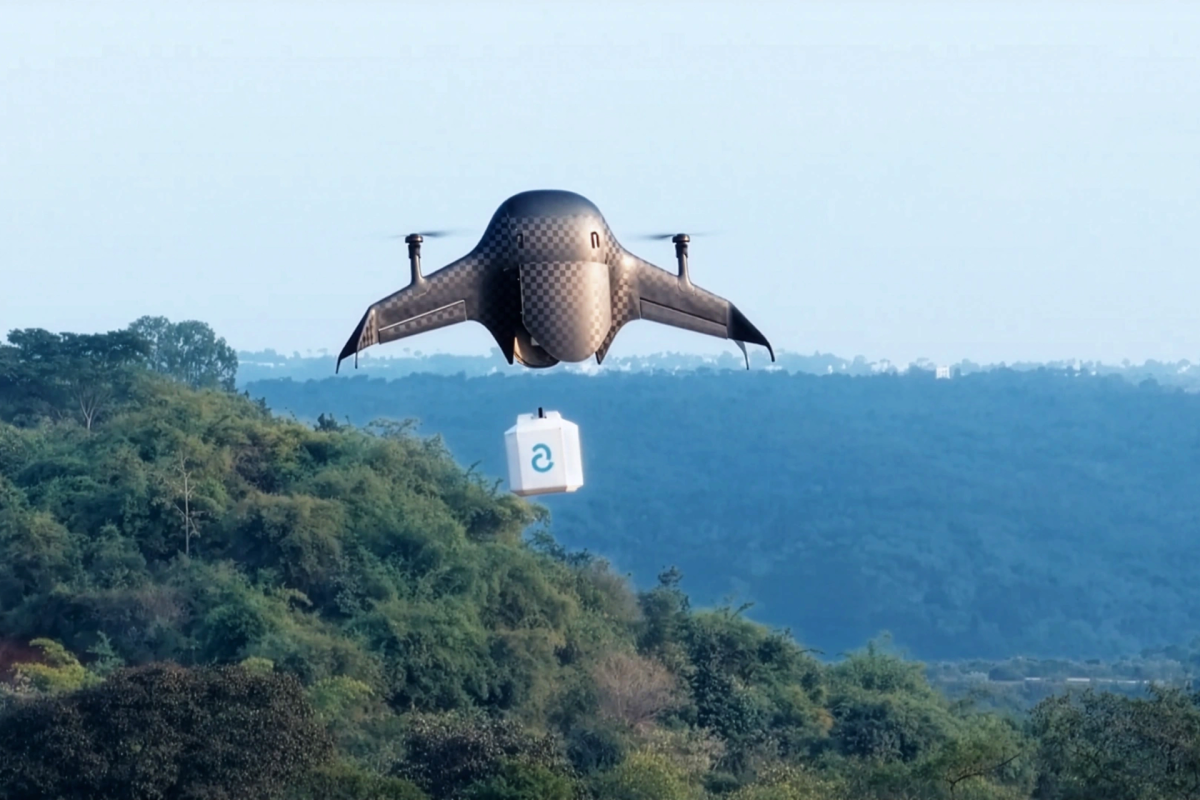
Conventional aircraft spend a lot of energy carrying their own weight rather than the payload, making flight expensive, particularly for moving smaller loads. Airbound’s answer is to build vertical-flight drones designed to weigh less than the cargo they carry, founder and CEO Naman Pushp said in an interview.

Airbound’s current drone, called TRT, weighs about 3.3 pounds and can carry around 2.2 pounds of payload. Its next version, currently under development, is expected to weigh about 6.6 pounds and be able to carry up to 11 pounds, Pushp told TechCrunch.

The startup uses a rocket-like, tail-sitter design for its drones, which takes off and lands vertically in an upright position before transitioning to horizontal flight. Pushp said Airbound intends to retain vertical takeoff and landing even as it develops larger aircraft to avoid dependence on runways.

“We want to build towards a world where everything has cost parity with trucking,” he said.

Founded in 2023, Airbound has completed more than 13,000 autonomous flights across the southern Indian cities of Bengaluru and Guntur, Pushp said. That includes more than 1,000 flights with the Indian hospital network Narayana Health, where its drones transport diagnostic samples between healthcare facilities.

The startup uses a single active drone on the Narayana route, flying diagnostic samples about 2.5 miles in around seven minutes. The same samples can take three to five hours to be transported by two-wheelers when factoring in the time spent waiting for enough samples to be bundled for road transport, according to Pushp.

That partnership is expanding to include Narayana’s new Banashankari hospital in Bengaluru, which was designed without an on-site diagnostic lab or blood bank and will instead rely on Airbound’s drones to connect with centralized facilities.

Three-city drone network

Airbound has set its sights on a far larger ambition to create a drone delivery network that connects three cities in the state of Andhra Pradesh. The startup has sign an agreement with the state government with an eventual target of 10,000 flights a day for retail, e-commerce, and healthcare deliveries. That daily flight target will require between 250 and 1,000 aircraft, depending on route lengths, though Pushp expects the number to be closer to 250.

The agreement does not involve a government contract or subsidy, Pushp said, adding that the Andhra Pradesh government is working with Airbound on the regulatory framework needed to enable the network. The startup expects to generate business from companies using it for deliveries.

Indian startups including Skye Air Mobility and TSAW Drones are already building aerial logistics businesses, while other Indian drone makers such as Garuda Aerospace have also explored delivery use cases. Nonetheless, Pushp argues that Airbound wants to build the aircraft that other logistics networks could eventually use rather than just trying to become the largest delivery operator.

“That’s the Boeing role — the aircraft airlines everywhere rely on, not the airline itself,” he said.

Airbound designs and manufactures its aircraft in a 43,000-square-foot facility in Bengaluru, where it keeps work on the airframe and other core systems in-house. While Pushp declined to disclose its production capacity or how many aircraft the startup has built so far, he said manufacturing would not be the bottleneck as Airbound scales.

The bigger bottleneck, Pushp noted, is regulation, particularly securing approvals for beyond visual line of sight (BVLOS) operations, a certification that allows drones to fly beyond the direct sight of an operator and is critical to operating delivery networks at scale.

Those regulatory constraints have also limited Airbound’s ability to turn its flights into meaningful commercial revenue. Moreover, the startup remains broadly pre-revenue despite having a team of more than 150 employees.

“The goal is to be a giant in a few decades, not to make revenue as soon as we can,” Pushp said.

When you purchase through links in our articles, we may earn a small commission. This doesn’t affect our editorial independence.

Continue Reading

Trending