News
From Super-Sub to World Cup Superstar! Kanyinsola Yusuf Wins FIFA Player of the Match as Flamingos Stun North Korea 3-1


Nigeria’s teenage sensation Kanyinsola Yusuf has emerged as one of the standout performers at the 2026 FIFA U-17 Women’s World Cup in Morocco after winning the Player of the Match award in the Flamingos’ sensational 3-1 victory over defending champions North Korea on Friday.
The prestigious individual recognition crowned an unforgettable afternoon for Yusuf, whose second-half goal helped Nigeria dismantle the tournament favourites and secure a place in the Round of 16.
Yusuf struck in the 56th minute to give Nigeria a commanding three-goal advantage, completing a remarkable attacking display against opponents who had scored 12 goals in their opening two group matches.
Oluwakemi Adegbuyi had opened the scoring in the 15th minute before Oluebube Umejiaku doubled Nigeria’s lead in the 38th minute, leaving the defending champions stunned at half-time.
North Korea pulled a goal back through Yu Jong Hyang’s 82nd-minute penalty, but the Flamingos held firm to record a famous victory.
For Yusuf, the individual honour represents another significant moment in a rapidly developing World Cup campaign.
The youngster had already made an impact in Nigeria’s opening 2-1 defeat to Poland, coming off the bench and helping spark a late fightback, before playing her part in the team’s recovery.
Her emergence adds another exciting dimension to coach Akeem Busari’s squad, which has transformed its fortunes after beginning the tournament with defeat.
Nigeria followed that setback with a 2-0 victory over Puerto Rico before producing Friday’s stunning performance against the reigning champions.
Yusuf’s award also means Nigerian players have claimed the Player of the Match prize in consecutive victories, following Adegbuyi’s recognition against Puerto Rico.
With the Flamingos now through to the knockout stage, Yusuf’s growing influence could prove crucial as Nigeria chase a historic first title.
From an impact substitute against Poland to a match-winning star against North Korea, Yusuf is rapidly making her name on the world stage.





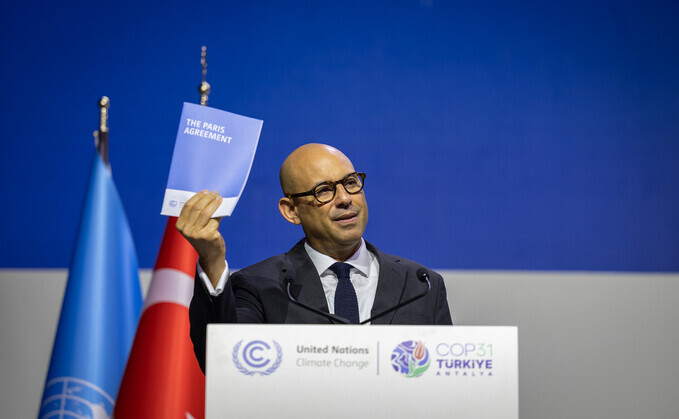
The executive secretary of UN Climate Change, Simon Stiell, told the ministers at COP31 that climate finance must be redesigned to lift developing countries out of a cycle of debt and disaster, adding that meeting a headline figure will not do it.
“Meeting a financial target does not always meet countries’ needs. To do that, we need to look at how finance is delivered,” Mr Stiell said on Friday at the opening of a high-level ministerial dialogue on climate finance in Antalya, Turkey.
Countries agreed at COP29 that developed nations would lead in providing $300 billion a year by 2035, as part of a wider effort to raise $1.3 trillion annually from all sources.
Mr Stiell said the roadmap for reaching those sums “must become reality”, but that the terms of the money mattered as much as the amount.
“Many developing countries are trapped in a downward loop of debt, disaster, and devastating capital costs,” he said. “The threat of floods, fires, storms and droughts hangs over them, pushing up the price of borrowing even before disaster strikes.”
He stated that the terms of finance should reflect each country’s debt position.


“Private finance, loans and guarantees are essential to achieving our collective goals. But grant-based and highly concessional finance will remain critical, particularly for Least Developed Countries, Small Island Developing States and other very vulnerable economies,” he said.
According to him, broader action on debt is also needed to prevent countries from being forced to choose between repayments and resilience.
International climate finance for developing countries reached about $137 billion in 2024, and almost 70 per cent of it came in the form of loans, according to a UN Women flagship report released on Tuesday in Antalya.
Countries in sub-Saharan Africa paid more than twice as much in external debt service between 2021 and 2023 as they received in climate finance, according to an analysis published by the Heinrich Böll Foundation.
The analysis found that interest payments consumed more than 10 per cent of government revenue in 27 African countries in 2024.
The chair of the African Group of Negotiators, Nana Antwi-Boasiako Amoah, has said that a transition could not be called just if poorer countries have to “mortgage their futures” to pay for it.
The group lost a bid on Monday for a separate agenda item on tripling adaptation finance. It now wants the target prioritised in the summit’s cover decision.
Nigeria is not on the UN’s list of least developed countries, which places it among the states the UN climate chief expects to rely more on loans, guarantees and private capital.
It needs about $337 billion between 2026 and 2035 to implement its climate commitments, according to the National Council on Climate Change.
Omotenioye Majekodunmi, the agency’s director-general, said more than 80 per cent of that will have to come from private investment, commercial debt, and international carbon finance.
About $2.5 billion a year went to climate action in Nigeria in 2021 and 2022, counting domestic and international sources, according to the Climate Policy Initiative’s tracking.
The dialogue was the last in a series that began in 2013, and its conclusions will go to COP32 in Ethiopia next year, Mr Stiell said.
Discover more from Premium Times Nigeria
Subscribe to get the latest posts sent to your email.

Every ₦1 spent on marketing communications generates an estimated ₦16.50 in Nigeria’s gross domestic product (GDP), highlighting the economic significance of the advertising industry as regulators push for stronger oversight of artificial intelligence (AI)-generated content and influencer marketing.
Dr. Olalekan Fadolapo, Director-General of the Advertising Regulatory Council of Nigeria (ARCON), disclosed the economic contribution, citing a PwC study, at the 2026 National Advertising Conference in Abuja on Thursday.
The disclosure places renewed attention on the economic value of Nigeria’s marketing communications industry, as the growing adoption of AI, social media advertising and influencer-led promotions creates new regulatory challenges around consumer protection, transparency and professional accountability.
Fadolapo said the industry must deliberately position itself to harness emerging technologies, increase its economic contribution and strengthen its competitiveness.

The disclosure places renewed attention on the economic value of Nigeria’s marketing communications industry, as the growing adoption of AI, social media advertising and influencer-led promotions creates new regulatory challenges around consumer protection, transparency and professional accountability.
“We must embrace emerging technology while preserving the creativity and professional standards that remain at the heart of effective marketing communication,” he said.
The economic multiplier cited by ARCON underscores the wider contribution of advertising beyond promotional activities, reflecting its relationship with business growth, consumer spending, media operations and the broader economy.
However, sustaining that contribution will increasingly depend on the industry’s ability to adapt to changing technology while maintaining consumer confidence and professional standards.
ARCON faces new regulatory questions over AI and influencer advertising
The economic significance of marketing communications comes as AI tools increasingly reshape how advertising campaigns are developed, targeted, distributed and measured.
At the conference, Mohammed Idris, Minister of Information and National Orientation, wants ARCON to develop practical regulatory approaches to emerging advertising practices, particularly digital advertising, influencer marketing and AI-generated content.
Idris, who was represented by Binyerem C. Ukaire, Permanent Secretary of the Federal Ministry of Information and National Orientation, said the rapid adoption of AI and the convergence of traditional and digital media were changing the structure of the marketing communications industry.
He identified authenticity, intellectual property rights, consumer privacy and accountability as critical issues requiring attention as advertisers increasingly incorporate AI into their operations.
“Our task, therefore, is to encourage innovation while ensuring that technology is deployed responsibly,” the Minister said.
The intervention highlights the growing difficulty of maintaining established advertising standards as brands adopt AI-powered tools to produce promotional content, personalise campaigns and engage consumers across digital platforms.
For regulators, the challenge includes determining how consumers can distinguish authentic promotional materials from synthetic content, who bears responsibility when AI-generated advertisements contain misleading claims, and how intellectual property rights should be protected when AI tools are used in commercial campaigns.
Idris identified the National Artificial Intelligence Strategy as an important framework for responsible technology adoption, noting that AI could improve audience analysis, content development, campaign planning and performance measurement.
However, he maintained that technological advancement must be accompanied by safeguards that preserve consumer confidence and professional integrity.
He also identified the Nigerian Data Protection Act 2023 and the ARCON Act 2022 as important legal frameworks for protecting consumers, promoting transparency and maintaining standards across the advertising industry.
“Trust is one of the most valuable assets in marketing communications,” Idris said, stressing the need for advertising practitioners to uphold ethical standards as new technologies transform the industry.
Influencer marketing and digital advertising under scrutiny
The regulatory concerns extend to influencer marketing, which has become an increasingly important channel through which brands reach consumers, particularly on social media platforms.
The growing use of digital personalities to promote products and services raises questions about disclosure of commercial relationships, misleading endorsements and the distinction between personal opinions and paid promotions.
As advertising expenditure increasingly flows into digital channels, the need for clear rules governing sponsored content and promotional claims has become more significant.
For ARCON, developing effective regulatory measures for these emerging practices will be important to ensuring that technological innovation does not weaken existing standards governing advertising content and consumer protection.
The challenge is particularly relevant to an industry whose economic contribution depends substantially on the credibility of promotional messages and the confidence consumers place in the brands and businesses behind them.
Without adequate disclosure and accountability, influencer-led campaigns and AI-generated promotional materials could expose consumers to misleading claims while creating reputational and compliance risks for advertisers.
The regulatory debate therefore extends beyond controlling new advertising formats to establishing the conditions under which innovation can support sustainable growth in the marketing communications industry.
NBC highlights audience measurement and independent verification
The National Broadcasting Commission (NBC) also highlighted the importance of reliable data and independent verification in strengthening Nigeria’s advertising ecosystem.
Dr. Charles Ebuebu, Director-General of NBC, who represented the heads of agencies under the Information Ministry, called for credible audience measurement, improved broadcasting data and stronger cooperation among regulators, advertisers and media organisations.
“Technology supplies data. Sound methodology and independent assurance give it value,” Ebuebu said.
His remarks draw attention to the growing importance of audience measurement as digital platforms and technology-driven advertising systems generate increasing volumes of data used by advertisers to assess campaign reach and effectiveness.
For businesses allocating marketing budgets across traditional broadcasting and digital channels, the reliability of audience information is important to determining whether advertising expenditure is reaching intended consumers and delivering measurable results.
Independent verification and credible measurement systems could therefore strengthen accountability across the advertising value chain, particularly as advertisers seek to compare the performance of different media channels.
Government seeks stronger Nigerian advertising industry
Beyond regulation and technology adoption, the Federal Government urged advertising professionals to invest in local talent, strengthen professional capacity and develop content capable of competing in international markets.
Idris said opportunities under the African Continental Free Trade Area could help Nigerian advertising and creative businesses expand their reach, provided the industry combines technological advancement with human creativity and professional responsibility.
The message reflects the government’s broader interest in positioning Nigeria’s creative and marketing communications industries for greater economic contribution and international competitiveness.
For the advertising sector, the opportunity lies in translating its economic multiplier into sustainable growth through stronger local capabilities, improved technology adoption, professional development and access to wider markets.
The 2026 National Advertising Conference brought together advertising practitioners, regulators, government officials, media executives and other industry stakeholders to examine opportunities for innovation, collaboration and sustainable growth in Nigeria’s marketing communications sector.
The conference comes as the industry faces a period of significant structural change, with AI and social media reshaping advertising production, distribution and measurement.
The ₦16.50 GDP contribution for every ₦1 spent on marketing communications provides an important measure of the industry’s economic relevance. However, maintaining and expanding that contribution will require a regulatory environment capable of accommodating technological innovation while protecting consumers, strengthening transparency and preserving confidence in advertising.
For ARCON and other industry regulators, the task is to ensure that the next phase of Nigeria’s advertising growth is supported not only by increased digital adoption and creative innovation, but also by credible standards, professional accountability and reliable measurement of the value advertising delivers to the economy.
-

 News4 days ago
APM holds Presidential Campaign in Plateau, Pledges Security and Economic Reset
-
News1 day ago
UNIJOS Appoints Patricia Lar as First Female Vice-Chancellor
-
News3 days ago
NiYA: Nigeria Awards ₦49m grants to 17 young entrepreneurs – Technology Times
-
News4 days ago
NPFL Matchday 12 Roundup: Rangers Edge Kwara United, Bendel Snatch Late Winner as Inter Lagos Rescue Derby Point