Connect with us

Business

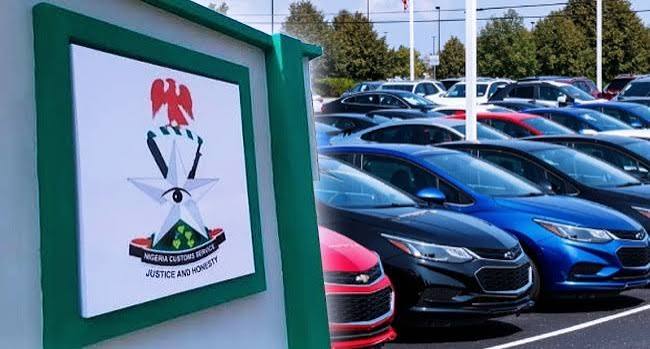
Customs announces lower tariffs on imported vehicles, sets ₦11tn revenue goal

info

Published

on

Images (3)

The federal government has reduced import duties on both new and used vehicles under its 2026 fiscal policy measures, the Comptroller-General of the Nigeria Customs Service (NCS), Adewale Adeniyi, has disclosed.

Mr Adeniyi announced the tariff review on Monday while defending the service’s 2026 budget proposal before the House of Representatives Committee on Customs and Excise.

He stated that the import duty on used vehicles has been lowered from 15 per cent to five per cent, whilst the rate for brand-new vehicles has been cut from 20 per cent to 10 per cent.

According to him, the revised tariff regime forms part of the government’s broader fiscal policy for 2026 and is expected to support economic activity. However, it could reduce customs revenue from vehicle imports.

“We have the new excise tariff, which is provided in the 2026 fiscal policy. We believe that these measures will increase our revenue collection,” Mr Adeniyi told the lawmakers.

“Conversely, during the same tariff measures that were given to us, tariffs on vehicles and levies on vehicles have been reduced significantly. For used vehicles, the tariff has been reduced from 15 per cent to 5 per cent, and for brand-new vehicles, from 20 per cent to 10 per cent. So, we believe that this is something that may also negatively affect revenue,” he added.

Lawmakers react

During the session, Alex Mascot (Abia State) questioned whether the reduction would be sufficient to discourage importers from diverting cargo through neighbouring ports, particularly Cotonou.

“If five per cent has been reduced from the fee that is paid when you import goods into the country, why then do people still move their goods to Cotonou?” he asked. He argued that high import charges had long pushed many traders to clear their goods outside Nigeria and urged the Customs Service to assess whether the new policy would address the challenge.

Responding, Mr Adeniyi said implementation of the revised tariff structure commenced in May.

Chairman of the committee, Leke Abejide (APC, Kogi), welcomed the policy, describing it as a positive step for Nigerians. He said many citizens had consistently demanded lower vehicle import duties and commended President Bola Tinubu’s administration for approving the reduction.

2025 budget performance

Mr Adeniyi also presented the NCS 2025 revenue performance, revealing that the service generated ₦7.258 trillion between January and December, surpassing its approved target. He said the figure exceeded the annual target by ₦1.153 trillion, representing an 18.89 per cent increase.

Despite the strong performance, he noted that several government policies constrained revenue collection during the year. These included the suspension of excise duty on telecommunications services, the continued suspension of the proposed green tax introduced in 2023, and fiscal incentives aimed at encouraging local production of healthcare products, which reduced customs duty and Value Added Tax (VAT) collections on imported medical items.

He added that the presidential initiative promoting Compressed Natural Gas (CNG) and electric vehicles also reduced revenue from imports in those sectors.

According to him, revenue was further affected by the large volume of imports granted concessions through Import Duty Exemption Certificates (IDEC), VAT orders, and Schedule II of the Common External Tariff (CET). Mr Adeniyi disclosed that imports valued at ₦34.538 trillion benefited from various revenue waivers in 2025. Petroleum products accounted for 56.40 per cent of the concessions, military imports made up 40.52 per cent, whilst IDEC and other qualifying imports represented the remaining 3.08 per cent.

He also cited disruptions to global trade caused by the Russia-Ukraine war, particularly its impact on wheat imports into Nigeria.

Customs projects ₦11.074tn revenue in 2026

Looking ahead, the Customs Service is targeting ₦11.074 trillion in revenue for the 2026 fiscal year. Mr Adeniyi said the projection comprises ₦5.542 trillion for the federation account, ₦1.491 trillion in non-federation revenue, ₦2.773 trillion from import VAT, and ₦1.266 trillion from free-on-board (FOB) collections.

To achieve the target, he said the service would accelerate the deployment of the Unified Customs Information System (UCIS), also known as B’Odogwu, to automate customs operations and improve efficiency. Other strategies include expanding post-clearance and real-time audits to strengthen compliance, extending the Authorised Economic Operator (AEO) and advance rulings programmes to facilitate trade, deploying geospatial technology and joint border patrols to combat smuggling, and deepening engagement with stakeholders.

Mr Adeniyi added that the implementation of the new excise tariff regime, the planned reintroduction of the green tax, and other fiscal measures would strengthen revenue generation despite uncertainties in global trade arising from geopolitical tensions involving the United States, Israel, and Iran.

Proposed expenditure

The Customs Service is proposing an expenditure of ₦1.235 trillion for the 2026 fiscal year. According to Mr Adeniyi, the budget will be financed through ₦949.86 billion from the four per cent FOB allocation, ₦55.47 billion from its two per cent share of VAT revenue, and ₦230.04 billion earmarked for ongoing capital projects.

The proposed spending includes ₦421.70 billion for personnel costs, ₦307.77 billion for overheads, and ₦565.93 billion for capital expenditure.

Continue Reading
Click to comment

Leave a Reply

Your email address will not be published. Required fields are marked *

Business

Keyamo approves design for Lagos airport monorail

info

Published

on

699907411 3001012880104792 589827653028784081 n.jpg

Minister of Aviation and Aerospace Development Festus Keyamo has approved the design of a proposed monorail to link Ikeja Railway Station in Lagos to Murtala Muhammed International Airport (MMIA) in the state.

The project is expected to connect the airport to the Lagos Red Line rail network, providing passengers and other airport users with an alternative to road transport.

Mr Keyamo announced the approval on Tuesday after a meeting with the managing director of the Federal Airports Authority of Nigeria (FAAN), the permanent secretary of the Federal Ministry of Aviation and engineering teams from the ministry and FAAN.

In a post on X, the minister said the proposed line will have five stations, running from Ikeja Railway Station to the international airport’s Terminal 1, which is currently undergoing reconstruction.

He listed the proposed stations/stops as Ikeja Station, Domestic Airport Station, Beesam Station, Toll Gate Station and MMIA Airport Station.

“The monorail is an integral part of the reconstruction of the nation’s major gateway at the MMIA in Lagos,” Mr Keyamo said.


PT WHATSAPP CHANNEL
Dangote Refinery AD

The design approval follows earlier announcements by the Federal Government about plans to extend rail services from Ikeja to the airport’s domestic and international terminals.

In June, PREMIUM TIMES reported that the government was working with the Lagos State Government to extend the existing rail network to the airport and to expand connectivity.

Recently, Olubunmi Onabanjo-KukuFAAN’she managing directAN, said talks on financing the planned airport rail lint had reached an advanced stage.

Speaking at the World Aviation Festival in Lisbon, Portugal, on 18 October, Ms Onabanjo-Kuku stated that efforts were ongoing to finalise the project’s financing structure.

The planned link is expected to connect the airport’s three terminals to the Red Line as part of its wider modernisation programme.

The proposed rail connection forms part of broader efforts to upgrade facilities at the Lagos airport and improve passenger movement.

Terminal 1 of the international airport is undergoing reconstruction, while other infrastructure upgrades are intended to boost airport operations and the passenger experience.

The airport serves as a major gateway for international travel to and from Nigeria, making access to its terminals crucial for passengers and other users.


Discover more from Premium Times Nigeria

Subscribe to get the latest posts sent to your email.

Continue Reading

Business

Mbah Rebuilds Technical College, Prepares Enugu Youths for Tech-Driven Future

info

Published

on

Enugu State Governor, Peter Ndubuisi Mbah, has rebuilt Government Technical College (GTC), transforming the once-dilapidated institution into a modern Science, Technical and Vocational education hub equipped with advanced ICT infrastructure, robotics, mechatronics and coding facilities to prepare young people for a technology-driven future.

The initiative forms part of his administration’s broader efforts to strengthen technical education, develop industry-relevant skills and position Enugu youths to take advantage of emerging economic and technological opportunities.

The comprehensive overhaul features newly constructed academic blocks, paved internal roads and upgraded learning facilities, alongside modern ICT infrastructure and industry-grade equipment supporting robotics, mechatronics, coding and programming.

Beyond its infrastructural renewal, GTC is pioneering specialised learning pathways in Science and Technology, Building and Architecture — covering trades such as bricklaying, electrical installation, plumbing and roofing — as well as Industrial Agriculture.

The integration of a Smart Green School within the college premises further creates a pathway linking foundational education with technical and vocational training, preparing students to develop practical competencies from an early stage.

Significantly, GTC is the first of eight planned model Science, Technical and Vocational Schools, with one envisaged for each of Enugu State’s eight federal constituencies. The initiative reinforces the administration’s commitment to expanding access to technical education, nurturing innovation and building a skilled workforce capable of supporting the state’s industrial and economic ambitions.

This is more than the reconstruction of an educational institution. It is an investment in human capital, youth empowerment and the next generation of skilled professionals, innovators and entrepreneurs.

Under Governor Mbah’s leadership, the focus is not merely on building structures, but on creating opportunities, strengthening institutions and laying the foundation for sustainable prosperity.

Sometimes, the picture says it all. Look beyond the structure and see the vision, the investment and the future being built.

The post Mbah Rebuilds Technical College, Prepares Enugu Youths for Tech-Driven Future appeared first on Business Today NG.

Continue Reading

Trending