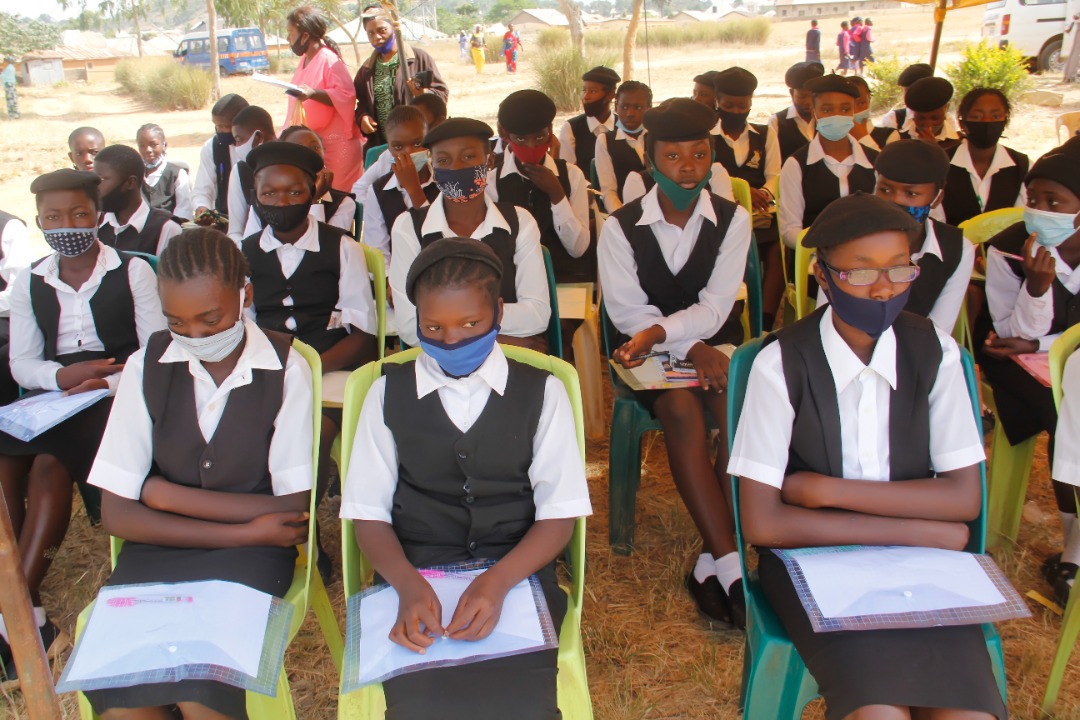
Farmer-Herder Clashes: IGSR holds Community Dialogue with 201 stakeholders in Plateau
Institute of Governance and Social Research (IGSR) in collaboration with the Global Community Engagement and Resilience Fund (GCERF) organized a Community Dialogue on the theme: “Addressing the Root Causes of Farmer-Herder Clashes and Other Crimes in Communities within Plateau Central Senatorial Zone”.The programme was a one-day event which held in two batches, A and B, on 30th and 31st of March, 2021. The venue was at the youth Center, Panskin Local Government Area. This programme was carried out in adherence to health advisories on COVID-19 preventive measures. The dialogue had a total of 210 (Two Hundred and Ten) participants in attendance from Plateau Central Senatorial Zone (Kanam, Kanke, Pankshin, Mangu and Bokkos).
Some of the participants in attendance includes: Traditional Leaders (District Heads and Ward Heads), Community Leaders (Ethnic and Group leaders), Security Agencies (Police, NSCDC, Operation Rainbow, DSS, NDLEA, etc.), Media (PRTV and Tin City), Professional Associations (such as Lawyers, Doctors etc.), Women Leaders, Youth Leaders, Religious Groups (JNI and CAN), CSOs, Academia’s, Government Representatives, Vigilante Groups (PCRC, VGN and NHW, etc.) and Youth Peace Ambassadors. The community dialogue was moderated Dr. Gideon Gwimbe Barde, a former Press Secretary to Governor J.D Gomwalk and Abdullahi Mohammed and one time Hon. Commissioner, Second republic (1979-1983).
The core objective of the community dialogue was to analyze the underlying factors responsible for the increase in farmer-herder clashes and other crimes in Plateau Central. More specifically, the community dialogue seek to; encourage face-to-face exchange of information among community members in order to foster mutual understanding and harmony, encourage diverse ethnic, religious and/or social groups to work on their difference in a non-violent way, increase community-driven actions towards the prevention of violent conflicts and engage community members in a process to enhance awareness raising, sensitization and collaborative problem solving in order to address specific issues of concern in their communities.
During the Dialogue participants were given opportunities to voice out their opinions, brainstorm and exchange ideas as well as learn from each other, they had different opinions on the Root Causes of Farmer-Herder Conflicts and Other Crimes in the Communities, some of the observations, resolutions and recommendations were made as follows:
Some of the causes of Farmer-Herder conflict identified at the dialogue include:
Destruction of farmers’ crops by the herders.
Population expansion has led to blockage of routes previously used by the herders and this has led the herders to open up new routes which often lead to conflict.
Bush burning by local hunters or villagers provokes the herders as it rids their animals of food.
Biased reporting by journalists either escalating or misreporting issues relating to farmers and herders.
Ethnic and religious intolerance between the different groups.
Underage or juvenile herders are left alone to steer a herd of cattle.
Illiteracy is a major concern among farmers and herders.
Delayed justice by the judiciary leaves persons to take laws into their hands.
The influx of strangers without the knowledge of indigenes poses a huge threat to security in communities.
The resolutions made were:
Farmers and herders should work together to define grazing routes and plough areas.
Government should make laws to stop underage or juvenile herders.
Religious leaders should preach messages of love and peace without prejudice.
Security Agencies should be sincere and prompt in responding to complaints.
The ban on proliferation of arms and light weapons should be enforced by the Security Agencies
Religious and ethnic tolerance should be promoted by parents, teachers, religious leaders and the media.
The government should address the issue of porous borders.
Recommendations
Government should create more jobs for the youths to prevent them from participating in criminal activities.
Traditional rulers should put partisanship and partiality aside to dispense justice to their subjects.
Open grazing has become outdated and is capable of leading to increase in conflict. Ranching should be adopted as an alternative to open grazing.
The populace must learn to hold the government accountable for their actions and inactions.
The stakeholders from the various communities should speak through their traditional rulers in order to harmonize and prioritize community needs. Stakeholders must awaken to their responsibilities.
There must be sharing of information between ethnic and religious groups in order for the relevant authorities to act on information which is critical in maintaining peace and order.
At the end of the community dialogue a communiqué was drafted, adopted and signed on behalf of the participants by representatives of the five LGAs on the 30th and 31st of March, 2021.
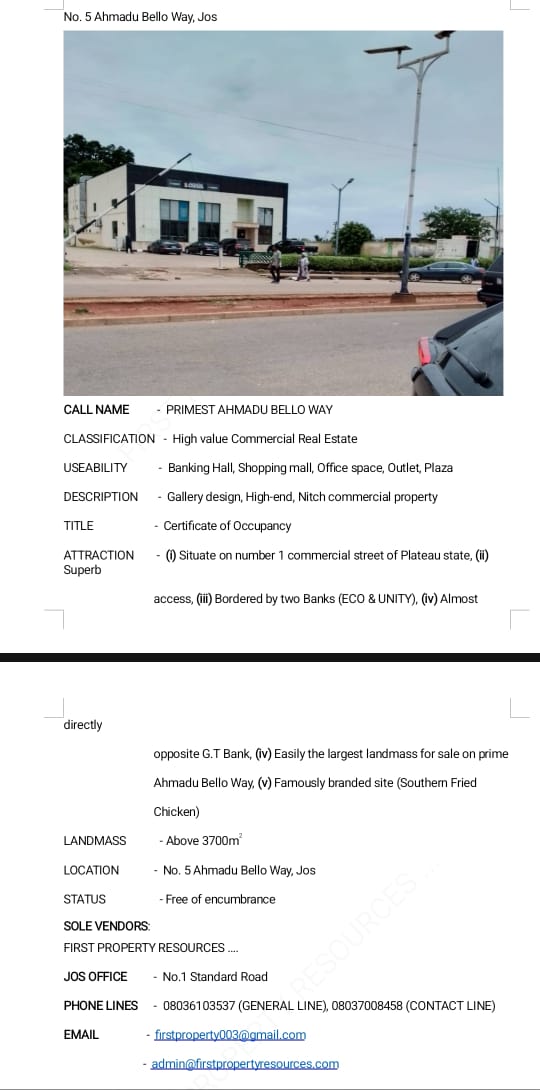
This top of the class commercial property is special for its prime location, expanse and usability advantage. It offers a rare advantage in proximity, vintage and class. Situated on the number one (No.1) commercial street of Plateau state, it is bordered on both sides by ECO and UNITY Banks. Famously housing Southern Fried Chicken (SFC), it is a unique ownership for investors, business owners or status symbol.
If you’re looking for a premium investment opportunity in the heart of Jos, this exceptional commercial property on Ahmadu Bello Way offers unmatched value, visibility, and versatility.
Property Overview
Situated at No. 5 Ahmadu Bello Way, widely regarded as the number one commercial corridor in Plateau State, this high-end property is ideal for a wide range of business uses including a banking hall, shopping mall, office complex, retail outlet, or plaza.
Key Features
Gallery-style architectural design with a modern, high-end finish
Spacious landmass of over 3,700m² — one of the largest available on this prime street
Certificate of Occupancy (C of O) ensuring secure and verifiable ownership
Free from encumbrances — ready for immediate transaction
Previously occupied by a well-known brand (Southern Fried Chicken), adding commercial prestige
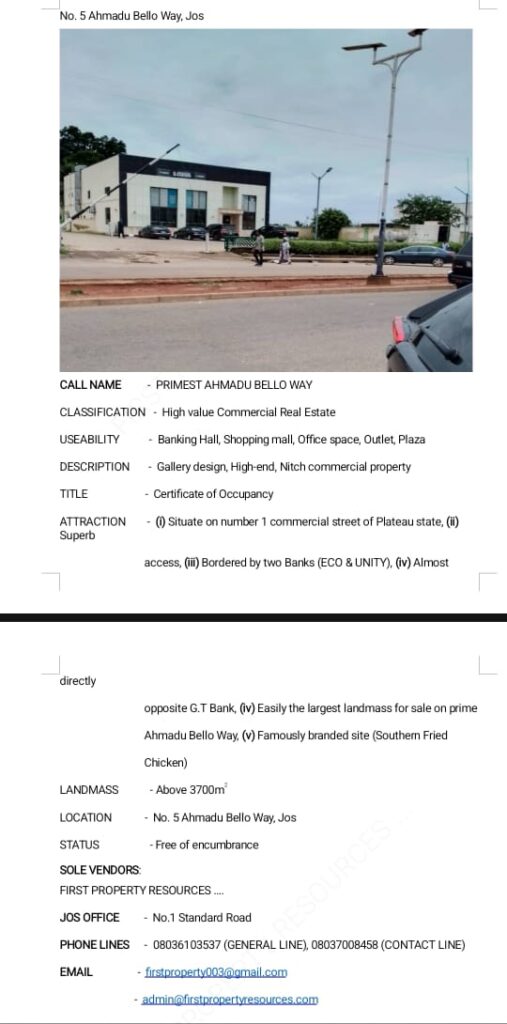
Prime Commercial Property for Sale on 5 Ahmadu Bello Way, Jos
Strategic Location Advantage
This property boasts a superb location with excellent accessibility and strong commercial appeal:
Located on Jos’ busiest and most sought-after business axis
Bordered by major financial institutions including ECO Bank and Unity Bank
Almost directly opposite GTBank, ensuring high traffic and visibility
Ideal for businesses seeking prominence and easy customer access
This is a rare opportunity to acquire a landmark commercial property in a prime location. Whether you’re an investor or business owner, this property offers the perfect blend of size, visibility, and strategic positioning to elevate your enterprise.
Prime Commercial Property for Sale on 5 Ahmadu Bello Way, Jos
Stakeholders from across Plateau State have issued a communiqué outlining key challenges and recommendations for addressing farmer-herder conflicts, criminality, and land disputes in the state.
The communiqué was released at the end of a two-day Multi-Level and Multi-Sectoral Roundtable on Sustainable Peace Infrastructure held at Novel Suites, Jos, from April 21 to 22, 2026.
The roundtable brought together government officials, traditional rulers, civil society organizations, security agencies, women and youth groups, as well as other critical actors to deliberate on strategies for strengthening peace and stability in Plateau State.
Focus on Dialogue and Sustainable Peace
Participants said the engagement provided a platform to examine the root causes of recurring conflicts and develop actionable strategies to promote peaceful coexistence.
The discussions, which included two panel sessions, explored issues around criminality, land disputes, and farmer-herder tensions, with emphasis on building trust, enhancing coordination, and strengthening existing peace structures.
Key Challenges Identified
In the communiqué, stakeholders highlighted several interconnected challenges fueling insecurity in the state.
Top among them were persistent security threats, including cattle rustling, kidnapping, illegal mining, and arms trafficking, as well as difficulties in identifying perpetrators, particularly alleged foreign elements.
They also pointed to weak law enforcement, limited trust between communities and security agencies, and operational challenges faced by security personnel.
Farmer-herder tensions were attributed to crop destruction, retaliatory attacks, underage grazing, and increasing competition over land and natural resources due to population growth.
Land-related conflicts, including land grabbing, poor documentation, displacement, and weak enforcement of land laws, were also identified as major drivers of violence.
Other concerns raised included governance gaps, lack of political will, inadequate identification systems, poverty, and limited access to modern agricultural practices.
Participants further decried the role of misinformation and unprofessional reporting in escalating tensions, as well as the impact of gender-based violence and the marginalization of women and vulnerable groups.
Stakeholders Proffer Solutions
To address these challenges, stakeholders called for strengthened security and justice systems through improved collaboration among security agencies, enhanced intelligence gathering, and the deployment of technology.
They also recommended continuous dialogue between farmers and herders, establishment of early warning systems, and the creation of joint platforms for resolving disputes.
On land governance, participants urged the government to enforce land laws, improve land documentation, and ensure fair resettlement processes for displaced communities.
They further advocated for the adoption of modern farming and livestock practices, including access to financial and technical support, improved seeds, and better farm security measures.
Stakeholders emphasized the need for inclusive governance, calling for the integration of herders into formal security structures and stronger collaboration between government and communities.
They also stressed the importance of responsible journalism and conflict-sensitive reporting, as well as the enforcement of laws addressing gender-based violence and the inclusion of women in peacebuilding efforts.
Commitment to Lasting Peace
The stakeholders reaffirmed their collective commitment to addressing the root causes of conflict and building resilient communities across Plateau State.
They urged the government to implement past recommendations, strengthen citizen engagement, improve population data systems, and facilitate the safe return of displaced persons.
The communiqué concluded with a call for sustained collaboration among all actors to ensure a peaceful, stable, and prosperous Plateau State.